The Complete System for Corporate Headshot Photography

Corporate headshots are not portraits. They are controlled identity outputs.
That distinction matters more than most photographers realize at the start.
A portrait is about expression. A corporate headshot is about function.
It has to survive across:
- websites
- LinkedIn profiles
- press pages
- internal directories and
- investor decks.
It also has to stay consistent when applied to people who do not think, behave or present themselves the same way on camera.
That is where most approaches fail.
Not in lighting.
Not in camera settings.
In structure.
Corporate photography is a system problem not a creative one
The real challenge is not photography. It is everything around it.
You are constantly managing three things at once:
- Organizational alignment
- Decision overload
- Consistency under human variability
If any one of these breaks the entire shoot becomes unstable.
Organizational alignment is the hidden bottleneck
Most companies do not enter a shoot with a clear visual definition.
HR wants approachable employees.
Leadership wants authority.
Marketing wants brand consistency.
Individuals just want to look like themselves on a good day.
None of these are wrong. But they are not automatically aligned.
Without clarity upfront, the camera becomes a negotiation tool.
That is where shoots slow down and consistency starts to fall apart.
Decision overload shows up in unexpected places
Corporate headshot sessions fail quietly through too many small decisions.
Lighting style.
Background tone.
Expression direction.
Cropping rules.
Retouching level.
File formats.
Selection process.
Individually, these seem simple.
Together, they create cognitive overload for both client and photographer.
When decisions are not locked before shoot day, they migrate into the shoot itself. That is when efficiency disappears.
Consistency under human variability is the real test
You are not working with models.
You are working with employees, executives and teams.
Some are confident.
Some are uncomfortable.
Some overthink every instruction.
Some want to finish in thirty seconds.
Your system has to hold through all of it.
Consistency does not come from controlling people. It comes from controlling the environment, the direction and the decision structure around them.
This is not about style. It is about repeatability
This guide is not a collection of aesthetic preferences.
It is a repeatable production system for corporate headshot photography.
It is designed for real environments where:
time is limited
people are unpredictable
decisions must be standardized
and output needs to stay consistent across large groups
The goal is simple.
Build a workflow that produces reliable professional corporate headshots at scale without losing clarity, control or brand consistency.
1. THE CORE MODEL (HOW CORPORATE HEADSHOTS ACTUALLY WORK)
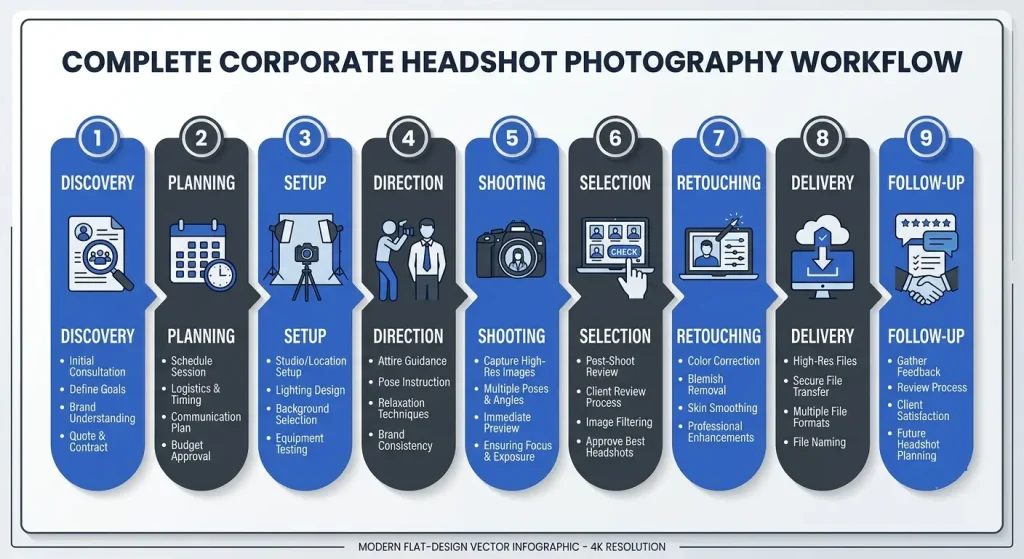
1.1 The Corporate Headshot System Stack
Corporate headshot photography is not a single skill.
It is a stacked system.
Each layer depends on the one before it.
If one layer is weak, the final output collapses in ways clients can usually feel but not always articulate.
This is how a real corporate headshot workflow actually operates.
Discovery (identity definition)
This is where the visual direction is defined before a camera is ever used.
You are not asking “what style do you want.”
You are defining:
what the company wants to communicate
who the audience is
what level of authority or approachability is required
how the brand currently exists visually
If Discovery is weak, everything after becomes guesswork.
Planning (constraint design)
Planning is where you remove uncertainty before shoot day.
This is where you decide:
time per person
background and lighting style
file structure and delivery format
employee flow and scheduling system
consistency rules across the team
Good planning reduces decision making during the shoot. That is the entire point.
Setup (environment stabilization)
This is where the system becomes physical.
You are building a controlled environment:
fixed camera position
repeatable lighting setup
consistent subject distance
defined shooting zone
clear movement flow for people
If Setup is inconsistent, Direction becomes harder and results drift.
Direction (behavioral control)
This is where most photographers actually think the job begins. It is not.
Direction is about reducing self awareness, not increasing performance.
You guide:
posture without stiffness
expression without forcing
eye contact without tension
confidence without overacting
Good direction feels simple to the client. That is a good sign.
Shooting (expression capture loop)
This is the real production phase.
You are not “taking photos.”
You are running a loop:
observe
adjust
capture
refine
The goal is not volume. The goal is identifying usable expression moments under controlled conditions.
Selection (brand filtering)
Selection is where photography becomes strategy.
You are removing images that do not fit:
brand tone
expression clarity
organizational consistency
role expectations
Clients often think selection is about preference. In corporate work, it is about filtering.
Retouching (perceptual normalization)
Retouching is not enhancement. It is stabilization.
You correct:
temporary distractions
lighting inconsistencies
minor visual noise
You do not change identity. You refine perception so the image feels clean, consistent and believable across a full team.
Delivery (usage alignment)
Delivery is operational.
You are not sending files. You are ensuring usability.
That means:
correct formats for LinkedIn, web and print
clear folder structure per employee or department
consistent cropping standards
fast accessibility without confusion
If clients have to interpret files, delivery failed.
Follow-up (identity continuity)
Corporate photography is rarely one-time work.
Follow-up ensures:
new hires match existing visual systems
future shoots stay consistent
brand evolution does not break continuity
clients feel supported beyond delivery
This is where long-term relationships are built, not during the shoot.
1.2 The Real Product
Corporate headshot photography is often misunderstood.
It is not:
images
portraits
lighting setups
retouching quality
Those are outputs. Not the product.
The real product is:
A coherent visual identity system across an organization.
That system ensures that every employee regardless of role or personality appears as part of the same brand structure.
This is what companies are actually paying for, even when they say they “just need headshots.”
They are buying consistency at scale.
They are buying control over how their organization appears externally.
1.3 The Core Constraint
Every decision in corporate headshot photography eventually runs into one rule.
Consistency of system is more important than consistency of outcome.
Outcome consistency means every photo looks similar. That is the amateur interpretation.
System consistency means every photo is produced using the same rules. Even if individual faces, expressions and roles differ slightly.
This matters because organizations are not visually identical internally. They are structured, layered and hierarchical.
A rigid outcome-based approach flattens that reality.
A system-based approach preserves it without losing brand coherence.
That is the difference between a set of good individual portraits and a usable corporate visual identity.
2. DISCOVERY (IDENTITY ENGINEERING PHASE)
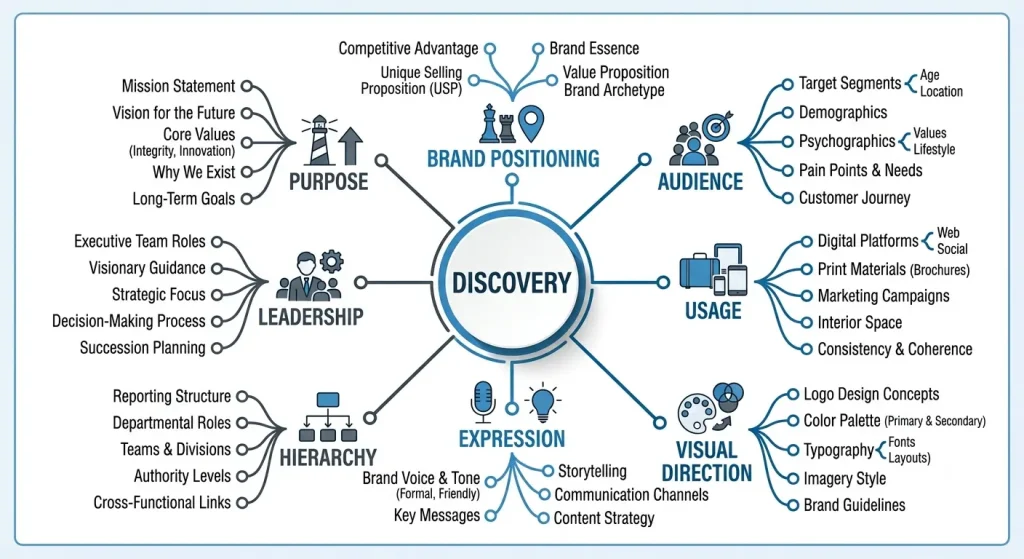
2.1 What you must define before photography
Discovery is where most corporate headshot problems are either solved early or guaranteed later.
If this phase is weak, no amount of lighting or posing fixes the outcome.
You are not collecting preferences. You are defining constraints.
Organizational purpose of the images
Start with why the images exist in the first place.
Most corporate shoots fall into a few categories:
recruitment and hiring
client acquisition and sales trust
investor and press communication
internal directories and company platforms
Each one changes how people should look on camera.
A recruiting-focused company needs warmth and approachability.
A finance firm speaking to investors needs stability and control.
A consulting firm often needs a balance of both.
Same camera.
Different purpose.
Completely different result.
Audience definition
You need to know who is looking at these images.
Not internally. Externally.
Typical audiences:
clients evaluating credibility
investors assessing leadership confidence
job candidates judging company culture
press and media outlets
If you don’t define the audience clearly, expression direction becomes guesswork.
Brand positioning
This is where visual tone is anchored.
Most companies sit somewhere between:
trust and stability
innovation and modernity
authority and leadership
warmth and approachability
You are not choosing one word. You are balancing tension between them.
For example:
finance often leans toward trust and control
tech leans toward innovation and accessibility
law leans toward authority and precision
If brand positioning is unclear, consistency becomes impossible to enforce.
Hierarchy sensitivity
This is often ignored and it creates silent problems later.
You need to understand:
should leadership look visually distinct
or should the organization feel flat and equal
Some companies want strict visual hierarchy.
Others want a fully democratic look.
Both are valid. But mixing them unintentionally creates confusion in final delivery.
2.2 Diagnostic questions
Good Discovery is not a long questionnaire. It is a set of pressure-testing questions that expose what the client actually needs versus what they initially say.
What do these images need to accomplish?
This forces clarity.
If the answer is vague, you have a risk project.
If the answer is specific like “help us look more credible to enterprise clients,” you have direction.
Where will they be used?
This determines everything.
LinkedIn requires clarity at small size.
Websites require consistency across teams.
Press requires leadership presence.
Internal systems require uniform identification.
Usage defines crop, lighting and expression more than aesthetics ever will.
What should people feel about this company?
This is where emotional positioning becomes visible.
Most clients struggle here at first.
But the answer reveals the real brand:
safe and stable
modern and fast
premium and selective
friendly and human
If you skip this question, you end up guessing emotional tone on shoot day.
What should people assume about leadership?
This is where hierarchy and authority come into focus.
Do they want leadership to feel:
approachable and collaborative
or decisive and authoritative
This question often exposes internal misalignment. That is not a problem. It is useful information.
2.3 Failure conditions in Discovery
Most corporate headshot problems start here, not on shoot day.
Multiple stakeholders with conflicting definitions
HR wants one outcome.
Marketing wants another.
Leadership wants something else entirely.
If all voices are treated equally during execution, the system collapses into inconsistency.
No agreed visual objective
If no one can clearly describe success, you are working blind.
“Make it look professional” is not a direction. It is a placeholder.
“Professional” ambiguity
This is one of the most dangerous words in corporate photography.
Professional for a startup is not the same as professional for a law firm.
Professional for recruitment is not the same as professional for investor relations.
If this word is not unpacked early, it will be reinterpreted during the shoot.
And that is where inconsistency starts.
2.4 Output of Discovery
At the end of Discovery, you should not have opinions. You should have decisions.
Defined visual direction
A clear statement of how the company should appear visually.
Not vague mood words. Actual direction:
controlled or relaxed lighting
formal or conversational expression tone
neutral or branded background approach
Defined expression range
You must decide what is allowed and what is not.
Examples:
neutral professional expression
approachable engagement
controlled leadership confidence
This prevents random interpretation on shoot day.
Defined consistency requirement
You define how strict the system is.
Do all employees look identical in tone?
Or is there slight variation by role?
This is where many projects fail if left undefined.
Because once people are in front of the camera, it is too late to decide what “consistent” means.
Discovery is not preparation.
It is identity engineering before production begins.
3. PLANNING (CONSTRAINT DESIGN SYSTEM)
3.1 Translating identity into visual rules
Planning is where corporate headshots stop being “creative photography” and start becoming a controlled system.
You already know what the company wants to communicate from Discovery. Now you translate that into repeatable visual constraints.
If you skip this step, every employee becomes a new creative decision. That is where consistency breaks.
Lighting direction
Lighting is not aesthetic. It is behavioral control.
You define:
Soft light for approachability and recruitment heavy brands
Directional light for authority and leadership presence
Higher contrast for finance, law, and executive positioning
Lower contrast for tech and modern corporate teams
Once selected, lighting does not change per person. It defines the entire identity language.
Background system
Background is not decoration. It is context removal or context reinforcement.
Common systems:
Clean neutral background for scalability and corporate consistency
Office environment for cultural storytelling
Brand color background for marketing alignment
The key rule is simple. One shoot, one background system unless hierarchy explicitly demands variation.
Expression language
This is where most photographers lose control.
Expression is not “smile or no smile.”
It is a controlled range.
Examples:
Authority focused expression for executives
Approachable neutral expression for client facing teams
Warm engagement expression for HR and recruitment roles
You are not letting people “be natural.” You are guiding them into defined behavioral zones.
Wardrobe constraints
Wardrobe is part of brand consistency.
You define boundaries:
Color palette alignment with brand identity
Avoiding high distraction patterns
Consistency across departments
Executive differentiation if needed, but still within system logic
The goal is not fashion. The goal is coherence across 50, 100, or 500 people.
Framing system
Framing decides hierarchy visibility.
You standardize:
Head and shoulders crop for consistency
Consistent camera height for uniformity
Controlled variation for leadership portraits when needed
Framing is where subtle hierarchy signals can exist without breaking system integrity.
3.2 Production structure
Corporate headshots fail when production is treated like a photoshoot instead of a workflow.
You design flow before people arrive.
Number of people
This determines everything.
5 people is a session
50 people is a production day
500 people is a multi-stage system
Scale changes the logic, not just the time.
Time per subject
Time is not flexible if you want consistency.
You define:
Standard employees: fast, repeatable capture windows
Executives: slightly extended time for direction and variation
No one is left to “figure it out in the moment”
Flow design
Flow is what keeps the system stable under pressure.
You structure:
Arrival
Brief adjustment and confirmation
Shooting station
Exit
No confusion. No waiting chaos. No decision bottlenecks.
Assistant roles
In larger shoots, assistants are not optional.
They manage:
Queue control
Wardrobe checks
Timing enforcement
Basic client reassurance
This protects the photographer from losing control of consistency due to logistics.
3.3 Risk mapping
This is where professional systems separate from beginner workflows.
You do not just plan what should happen. You plan what will go wrong.
Space limitations
Corporate offices are rarely ideal studios.
You anticipate:
Tight shooting zones
Low ceiling environments
Mixed practical lighting sources
You design around constraints instead of fighting them on site.
Scheduling breakdown
The biggest failure point is not lighting. It is timing.
You map:
Delays between departments
Executive priority interruptions
Employee availability variance
If you ignore this, consistency collapses halfway through the day.
Mixed lighting environments
Office light is unpredictable.
You plan for:
Window light contamination
Fluorescent color shifts
Overhead light interference
The system must overpower or neutralize all of it.
Employee preparedness variance
Not everyone arrives camera ready.
You expect:
Different grooming levels
Different wardrobe readiness
Different comfort levels in front of camera
Your system must absorb this without changing output quality.
3.4 Output of Planning
Planning is only successful if it produces two things.
A fixed visual system
At the end of planning, you should have:
One lighting setup
One background direction
One expression system
One framing structure
This is what guarantees consistency across the entire company.
A controlled production workflow
You also need operational clarity:
Who comes when
How long each person takes
How movement through the system works
How interruptions are handled
If this is not defined, the shoot becomes reactive instead of controlled.
A corporate headshot system is not built on flexibility.
It is built on constraint clarity.
4. SETUP (ENVIRONMENT CONTROL SYSTEM)
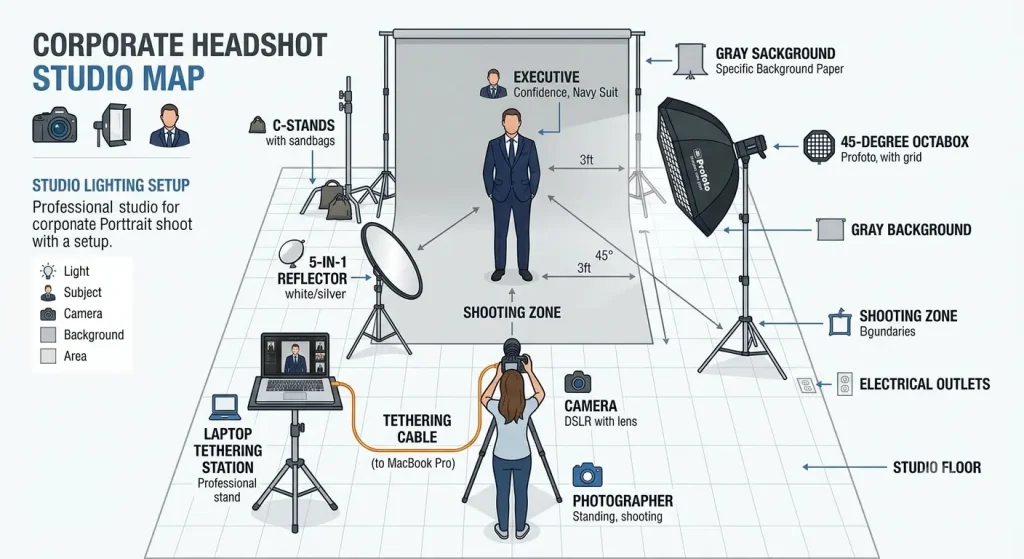
4.1 Location scanning logic
Setup starts before a single light stand is opened. You are not building yet. You are reading the environment.
Most corporate headshot failures come from ignoring the room and forcing a setup into it.
You don’t do that.
You scan first.
Light contamination
Office spaces are never clean lighting environments.
You identify:
Window light direction and intensity
Overhead fluorescent color shifts
Mixed temperature lighting in adjacent areas
Reflections from glass walls or polished surfaces
If you ignore this, your color consistency collapses immediately across employees.
Movement distractions
Corporate environments are alive.
People walk through frames. Phones ring. Meetings open and close.
You identify:
High traffic paths behind shooting zones
Visual interruptions in background areas
Sudden movement zones near the subject area
You are not just photographing a person. You are controlling what appears behind them.
Spatial flow design
You decide how people move through the space.
Not randomly. Intentionally.
Where they enter
Where they pause
Where they stand
Where they exit
If this is not defined, the shoot becomes chaotic and quality drops fast.
4.2 Physical system design
Now you start building structure inside the environment.
This is where a corporate headshot setup becomes repeatable.
Shooting zone
This is the controlled capture area.
It must be:
Clearly defined
Consistently positioned
Free from background interference
Every subject enters the same visual space.
No improvisation here.
Waiting zone
People always arrive early or in groups.
You need a separate area where:
Employees wait without disrupting the setup
Clothing and grooming can be adjusted
Nervous energy does not enter the shooting zone
If waiting bleeds into shooting, consistency breaks.
Transition path
This is the most overlooked part.
You define a clear path:
Waiting zone to shooting zone
No confusion
No crossing through active frame areas
No unnecessary stopping
This keeps psychological flow stable and production efficient.
4.3 Lighting system stabilization
Once space is structured, lighting becomes the backbone of the entire system.
This is not creative lighting. It is controlled identity rendering.
Key light position
The key light defines everything.
You lock:
Height relative to subject eye line
Angle of direction
Distance consistency
Once set, it does not move per person.
Fill ratio
Fill is not decorative. It controls emotional tone.
You decide:
High fill for softer, approachable corporate identity
Lower fill for stronger authority presence
Balanced fill for general corporate consistency
The ratio stays fixed across the entire session.
Background separation
Separation ensures the subject reads clearly against the background.
You control:
Distance from background
Light spill control
Edge definition around shoulders and hair
Without this, subjects visually merge into the environment.
Fixed geometry
This is the core rule most beginners miss.
Camera position does not drift.
Subject position does not drift.
Light positions do not drift.
You are building a geometric system not taking random portraits.
4.4 Calibration process
Before any employee steps in, you test the system.
Not for creativity. For stability.
Test subject before first client
You use:
Assistant
Stand-in subject
First employee with controlled expectations
You check:
Shadow behavior on face
Eye light consistency
Background exposure balance
Skin tone accuracy under final lighting
This is where you eliminate surprises.
Lock exposure, color, angle
Once calibration is correct, you lock the system.
Exposure does not change per person
White balance remains fixed
Camera angle stays consistent
If you keep adjusting during the shoot, consistency collapses over time.
Locking is what makes scale possible.
4.5 Output of Setup
Setup is successful only when one thing is true.
A fully repeatable capture environment
At this stage:
Any employee can step into the frame
Lighting behaves predictably
Background remains stable
Camera position produces consistent framing
You are no longer “setting up for a shoot.”
You are operating a controlled visual system that can run for hours without breaking consistency.
This is what separates corporate headshot production from general portrait photography.
It is not about capturing moments.
It is about building a stable environment where every moment looks like it belongs to the same system.
5. DIRECTION (HUMAN BEHAVIOR CONTROL LAYER)
5.1 Psychological state of subjects
Direction is where corporate headshots stop being technical and become behavioral control.
Most people think they are “bad at photos.” That is not the real issue.
The real issue is internal pressure.
Evaluation anxiety
The subject is constantly asking:
- Do I look professional enough?
- Am I doing this right?
- Is this what they expect?
This creates tension in the face and body before you even take a photo.
You are not fighting posing. You are fighting evaluation fear.
Self-monitoring behavior
People start watching themselves instead of expressing themselves.
They:
- Fix their posture repeatedly
- Adjust their smile unconsciously
- Overthink every movement
This destroys natural expression faster than any technical mistake.
Pose uncertainty
Most people do not know what to do with their body.
So they default to stiffness.
Hands freeze
Shoulders lock
Chin becomes controlled instead of natural
Your job is to remove decision making, not add instructions.
5.2 First 60 seconds protocol
The first minute decides the entire shoot.
If you lose this window, everything becomes mechanical.
Conversation-first approach
You do not start with posing instructions.
You start with normal human interaction.
Simple questions:
How is your day going?
Have you done headshots before?
What is this being used for?
The goal is not information. The goal is stabilization.
Removing “being photographed” awareness
The moment someone becomes aware of the camera, they perform.
So you delay that awareness.
You talk while adjusting gear
You keep interaction casual
You avoid formal positioning early
You are lowering the psychological weight of the camera.
Reducing cognitive load
People cannot think and express naturally at the same time.
So you reduce thinking.
One instruction at a time
No multi-step posing directions
No overwhelming feedback
You simplify everything until their brain stops analyzing.
5.3 Expression engineering
Expression is not natural. It is guided.
You are not waiting for the right face. You are constructing it through prompts.
Confidence prompts
Used for authority roles and leadership presence.
Examples:
Imagine you are explaining something important to a client
Think about a decision you are confident about
These create stable, grounded facial energy.
Warmth prompts
Used for approachable corporate identity.
Examples:
Think of someone you enjoy working with
Relax your expression like you are in a normal conversation
This reduces intensity and increases trust signals.
Leadership prompts
Used for executives and public-facing roles.
Examples:
You are presenting this idea to a board you respect
You are not posing, you are communicating
This shifts posture and eye engagement naturally.
You are not telling them how to look. You are shaping the internal context that creates the look.
5.4 Micro-direction system
This is where professional consistency is maintained.
Small adjustments. Not full re-poses.
Posture
You control:
Shoulders slightly forward, not pulled back rigidly
Chest open but not exaggerated
Neck lengthened, not compressed or overextended
The goal is controlled presence, not stiffness.
Eyes
Eyes are the anchor of the image.
You guide:
Direct connection through lens as if speaking to one person
Avoiding blank staring
Keeping attention engaged, not frozen
If the eyes fail, everything fails.
Expression range control
You do not allow unlimited variation.
You define:
Neutral professional expression
Slight warmth variation
Controlled smile range
This prevents identity drift across a team.
5.5 Failure signals
Experienced photographers do not just look for good images. They watch for breakdown patterns.
Forced smile
This is the most obvious failure.
Signs:
Mouth activated but eyes are disconnected
Smile held instead of expressed
Immediate drop after shutter click
This means emotional alignment has failed.
Stiff posture
The body becomes rigid instead of supported.
Signs:
Locked shoulders
Fixed neck angle
No natural movement between shots
This creates corporate “statue” energy instead of leadership presence.
Over-analysis behavior
The subject starts thinking mid-shoot.
Signs:
Constant self-adjustment
Asking “Is this right?”
Breaking flow after each shot
This is not a posing problem. It is a trust problem.
When you see these signals, you do not push harder.
You simplify direction.
You slow down the system.
You restore psychological comfort before continuing.
Direction is not about getting someone to smile.
It is about removing everything that prevents a natural, credible expression from appearing under controlled conditions.
When this layer works, people stop performing.
And that is where real corporate headshots begin.
6. SHOOTING (CONTROLLED EXPRESSION LOOP)
6.1 The capture cycle
Shooting is not random photography. It is a controlled feedback loop.
Every frame is part of a system, not an isolated moment.
The process stays consistent across every subject.
observe → position → test frame → adjust → refine → capture
Observe
Before shooting, you read the subject.
How they hold themselves
Where tension appears
How they naturally respond to direction
You are not rushing into photos. You are diagnosing behavior.
Position
You establish the base structure.
Feet stable
Shoulders aligned
Head angle set
Camera relationship defined
This is the foundation everything else sits on.
Test frame
First frames are not final images.
They are system checks.
You evaluate:
Expression readiness
Lighting response
Posture stability
This tells you what needs correction.
Adjust
Small corrections only.
Head angle shift
Shoulder relaxation
Eye direction refinement
No full resets unless the system is broken.
Refine
You guide the subject closer to alignment.
Less instruction
More confirmation
More consistency
At this stage, expression starts becoming repeatable.
Capture
Now you collect usable frames.
Not because you are hoping for a good one.
Because the system is producing them reliably.
6.2 Expression harvesting
You are not waiting for expressions. You are extracting them through controlled prompts and timing.
Each subject produces a range. Your job is to capture the useful parts of that range.
Confidence frame
This is the leadership baseline.
Used for:
Executives
Law
Finance
Professional authority roles
The expression is stable.
Grounded eyes
Controlled facial tension
No forced emotion
Approachable frame
This is the trust-building version.
Used for:
Sales teams
HR
Client-facing staff
Slight relaxation in facial muscles
Softened engagement
Natural openness without performance
Natural variation frames
These are not accidents.
They are behavioral variations captured during micro-movement.
Small shifts in:
Eye focus
Breath timing
Micro expressions between instructions
These frames often feel the most human because they are least performed.
6.3 Volume logic
Corporate headshots are not about high volume shooting.
They are about controlled selection density.
10–30 images per person
This range is intentional.
Too few images creates risk.
Too many creates confusion.
Within this range you get:
Multiple expression states
Micro posture variations
Selection flexibility without overload
Quality through controlled variation, not volume
The goal is not more photos.
It is better decision material.
You are not trying to overwhelm the edit process.
You are creating clear options that all match the same system.
Every frame should already feel usable.
6.4 Stability rules
Consistency is not maintained in editing. It is maintained during capture.
Fixed camera position
Camera height does not change.
Distance does not drift.
Angle remains locked.
This ensures identity consistency across all employees.
Fixed lighting
Lighting stays constant for every subject.
No re-lighting per person.
No creative adjustments mid-session.
The light defines the brand, not the individual.
Fixed workflow
Every subject moves through the same process.
Same direction structure
Same positioning system
Same capture rhythm
This removes randomness from production.
When stability is maintained, the shoot becomes scalable.
6.5 Output of Shooting
At the end of this phase, you do not have “photos.”
You have structured identity data.
Multiple usable identity-consistent frames per subject
Each person leaves the shooting process with:
At least one strong confidence-oriented image
At least one approachable variation
Additional frames that support selection flexibility
All images share the same visual language.
Same lighting behavior
Same framing logic
Same expression control system
This is the key outcome.
You are not creating isolated portraits.
You are producing a consistent visual identity set across an entire organization, where every individual still looks like themselves, but clearly belongs to the same system.
7. SELECTION (BRAND FILTERING SYSTEM)
7.1 Multi-stage filtering
Selection is where corporate headshots stop being photography decisions and become brand decisions.
This is the stage most people underestimate. They assume the shoot is finished. It is not. The identity system is still being refined.
You are not choosing “nice photos.” You are filtering what can represent the company externally.
Technical elimination
First pass is simple.
You remove anything that is not usable.
Out of focus frames
Blinking or mid-speech expressions
Exposure mistakes
Distracting movement
Technical failures
This step is not subjective. It is mechanical. If it is not technically clean, it is removed immediately.
Expression evaluation
Now you evaluate intent.
You are looking for expression clarity.
Does the face communicate anything at all
Is the emotion controlled or accidental
Does the subject look like themselves under professional context
This is where most average images get removed, even if they look “fine.”
Brand alignment check
Now you move from person to company.
You ask a different question.
Does this image match the company’s intended identity?
Examples:
A leadership role must communicate authority and clarity
A client-facing role must communicate trust and approachability
A tech brand must feel modern and accessible
Even a strong portrait gets rejected if it sends the wrong signal.
Consistency comparison
This is where corporate sets are won or lost.
You compare across people.
Not individually. Collectively.
Do they feel like one company
Is lighting consistent across the group
Do expressions sit within the same behavioral range
Does the visual tone stay stable from person to person
Selection is not about the best image.
It is about the most system-aligned image.
7.2 Selection hierarchy
Corporate headshot selection follows one strict rule.
Organization consistency comes before individual preference.
This is where most internal disagreements happen.
An employee may prefer an image that feels personal or flattering.
But the company needs something else.
A usable identity asset.
So the hierarchy is clear.
System consistency is the priority
Then brand alignment
Then individual preference
Then aesthetic taste
If you reverse this order, the entire set breaks.
You end up with strong individual images that do not belong together.
7.3 Client involvement model
Client involvement is not open browsing. It is guided decision-making.
The goal is not to overwhelm the client with choice.
The goal is to reduce decision noise.
Curated shortlist (not raw gallery)
You do not deliver everything.
You deliver a controlled selection.
Each person gets a filtered set of:
Technically valid images
Brand-aligned expressions
System-consistent options
This removes confusion immediately.
Clients are not photographers. They should not be asked to navigate 100 near-identical frames.
Controlled choice architecture
Clients can choose, but within boundaries.
You are not asking:
Which photo do you like
You are guiding them toward:
Which approved expression best represents your role
This shift matters.
It turns subjective preference into structured evaluation.
It protects the brand system while still respecting client input.
7.4 Failure modes
Selection is where good shoots get weakened after the fact.
The camera work can be perfect. The selection process can still destroy consistency.
Over-choice → weak brand identity
When clients are given too many images, something predictable happens.
They choose based on personal preference instead of brand clarity.
Results:
Inconsistent expressions across the company
Mixed visual tone on the website
Loss of identity coherence
Too much choice does not increase satisfaction. It increases randomness.
Democratic selection → diluted hierarchy
When too many stakeholders approve images, everything averages out.
Strong leadership images get softened
Distinct personalities get neutralized
Visual hierarchy disappears
The company starts to look flat, even if it is structurally hierarchical in real life.
This is not a photography problem.
It is a decision structure problem.
Selection is where the system either holds its identity or collapses into preference chaos.
The goal is simple.
Reduce noise.
Protect consistency.
Preserve the brand signal across every face in the organization.
8. RETOUCHING (PERCEPTUAL CONSISTENCY LAYER)
8.1 Retouching philosophy
Retouching is not where the portrait is fixed. It is where the system is finalized.
If the image needs heavy correction, the shoot already failed earlier in the pipeline. Good retouching starts with a strong capture.
The goal is simple.
Enhance clarity, not identity.
That means improving how the person is perceived without changing who they are.
In corporate headshots, trust is the product. And trust breaks the moment someone stops recognizing themselves.
So retouching is always minimal, controlled, and intentional.
You are not improving appearance. You are removing distraction from communication.
8.2 What is allowed
Retouching has a strict boundary. Anything inside this boundary supports clarity without altering identity.
Temporary skin correction
Small and temporary issues can be cleaned.
Minor blemishes
Temporary redness
Small surface distractions
The goal is to restore a neutral professional baseline, not create perfection.
Distractions removal
Anything that pulls attention away from the face can be removed.
Stray hairs
Dust or clothing lint
Small environmental distractions in background
These elements do not represent the person or the brand.
Light balancing
You can correct technical inconsistencies.
Exposure refinement
Subtle shadow balancing
Color correction for accurate skin tone
This ensures the image reads consistently across different devices and platforms.
8.3 What is forbidden
This is where most amateur retouching breaks corporate credibility.
Once identity is altered, the image stops being a headshot and becomes an artificial representation.
Face restructuring
You do not reshape people.
No jawline modification
No facial slimming
No altering bone structure
Corporate photography is not fashion editorial work. It must stay truthful.
Identity alteration
You never change how someone fundamentally looks.
No feature replacement
No exaggerated enhancement of traits
No “idealized version” creation
The image must remain recognizable in real life.
Over-smoothing
This is one of the most common mistakes.
Skin must remain real.
Texture matters
Pores are normal
Natural variation is expected
Over-smoothed skin reduces trust immediately, especially in corporate contexts.
Age removal
You do not erase time.
Wrinkles, lines, and natural age markers are part of professional identity.
Removing them creates a mismatch between photo and real-world presence.
And that mismatch damages credibility more than any minor imperfection ever could.
8.4 Consistency across teams
Retouching is not an individual process. It is a system process.
A company does not need 50 individually perfect images.
It needs 50 visually coherent representations of the same organization.
Uniform color science
Every image must share the same color logic.
Skin tones must match across subjects
White balance must remain consistent
Background tones must feel unified
Color inconsistency immediately breaks the perception of a single brand identity.
Uniform contrast curve
Contrast defines emotional tone.
If contrast shifts between employees, the brand feels fragmented.
So you standardize:
Shadow depth
Highlight roll-off
Midtone balance
This ensures every image feels like it belongs to the same visual system.
Uniform retouch philosophy
This is the most important rule.
Retouching style must not change per person.
If one subject is heavily retouched and another is barely touched, the system collapses.
Instead, you define one standard:
Same level of skin treatment
Same distraction removal approach
Same realism threshold
Consistency in retouching creates trust at scale.
Retouching is the final layer of control in the corporate headshot system.
Not to perfect people.
But to ensure every image still feels like it came from the same structured, intentional visual identity system.
9. DELIVERY (USAGE PROTECTION SYSTEM)
9.1 File architecture design
Delivery is not file transfer. It is system design for how the client will actually use the images.
If the structure is confusing, even great headshots get misused. If the structure is clean, the system stays intact long after the shoot is finished.
You are not just sending images. You are protecting how they are applied.
By department
Corporate teams need internal logic.
You organize by:
Leadership
Marketing
Sales
Operations
HR
This helps clients immediately understand who is who without searching through random files.
It also preserves organizational structure visually.
By employee
Each person gets a clear identity folder.
No ambiguity.
No mixing.
No confusion.
This prevents incorrect usage and ensures each employee can quickly locate their own approved image set.
By usage type
Different platforms require different outputs.
You separate:
Internal directory use
Website use
External communication use
This removes guesswork for the client and reduces misuse of files.
Most delivery issues happen because structure was never designed. Not because images were wrong.
9.2 Format engineering
A corporate headshot is not a single file. It is a set of outputs designed for different platforms.
If you only deliver one version, clients will stretch, crop, or compress it incorrectly.
So you engineer formats intentionally.
LinkedIn versions
LinkedIn has strict visual behavior.
You prepare:
Tighter crop for visibility
Centered composition
High clarity facial focus
Optimized resolution for profile compression
The goal is instant recognition at small size.
Web versions
Company websites require consistency and layout control.
You provide:
Standardized framing
Uniform background balance
Consistent aspect ratios across employees
These images are designed to sit together as a grid, not as individual portraits.
Print versions
Print requires flexibility.
You include:
Higher resolution files
Wider framing options
Less aggressive compression
These are used for brochures, press kits, and corporate materials where design needs space.
Each format serves a different function. Confusing them leads to brand inconsistency in public-facing materials.
9.3 Usability principle
This is the most important rule in delivery.
Client should not need technical knowledge.
If they have to ask:
Which file do I use
What size works for LinkedIn
Why are there multiple versions
Then the system has failed at the delivery stage.
A professional delivery removes all decision friction.
You design it so that:
The correct file is obvious
The structure explains itself
The usage requires no interpretation
Clients are not photographers. They should never feel like they are managing a technical archive.
Your job is to make the system invisible and intuitive.
If they think about file handling, you did not finish the job.
9.4 Output of Delivery
When delivery is done correctly, the client does not receive “photos.”
They receive a structured identity system ready for immediate use.
Self-explanatory image system
Every file tells the client:
Who this is for
Where it should be used
How it should appear
Nothing is hidden in instructions or emails.
The structure carries the meaning.
At this stage, the work is no longer about photography execution.
It is about ensuring the organization can deploy its visual identity without confusion, inconsistency, or error.
That is what separates a photographer from a corporate visual systems designer.
10. FOLLOW-UP (IDENTITY CONTINUITY SYSTEM)
10.1 Post-delivery validation
Most corporate photography jobs fail quietly after delivery, not during the shoot.
The files are sent. The project is “complete.” But the real question comes later.
Did the system actually work in the real world?
Follow-up is where you find out.
Usage confirmation
You check how the images are actually being used.
Not how they were approved. How they are deployed.
LinkedIn profiles
Company website team pages
Internal directories
Press materials or investor decks
If usage is inconsistent, the issue is rarely design. It is usually misunderstanding or lack of guidance.
Satisfaction vs effectiveness check
These are not the same thing.
A client can be satisfied and still not achieve the business goal.
So you evaluate both:
Do they like the images
Are the images actually improving perception, trust, or clarity externally
Corporate headshots are not about approval. They are about performance in context.
If the images are not working in the real world, the system needs adjustment, not praise.
10.2 Long-term asset building
Corporate headshots are not one-time deliverables. They are long-term brand infrastructure.
Each shoot becomes part of a growing visual system that evolves with the company.
Brand memory system
Every session adds to a visual database.
Lighting style
Expression language
Framing structure
Retouching consistency
Over time, this becomes the company’s visual memory.
New employees must match this system. Not reinvent it.
This is where consistency becomes an asset, not just a preference.
Visual consistency across years
Companies change.
People change.
Teams expand.
But the visual identity should not drift randomly.
Follow-up ensures:
New hires match existing visual tone
Leadership updates stay consistent with past imagery
Brand identity remains stable across time
Without this continuity layer, companies end up with visual fragmentation every 12–18 months.
10.3 Relationship model
At this stage, the role of the photographer changes completely.
It is no longer a one-time service provider relationship.
It becomes a system relationship.
Photographer becomes visual systems partner
The real value is not in a single shoot.
It is in maintaining continuity over time.
Understanding how the company presents itself
Keeping visual identity stable across hires and departments
Updating the system without breaking it
Reducing decision stress for internal teams
This is why corporate clients return.
Not because of individual images.
But because the visual system becomes predictable, stable, and scalable.
Corporate headshots are often misunderstood as photography.
In reality, they are a controlled identity system designed to survive scale, time, and organizational complexity.
When the system is built correctly, the company does not just get better photos.
It gets visual consistency it can rely on for years.
11. ORGANIZATIONAL FAILURE MODES
11.1 Where systems break
Corporate headshot systems rarely fail because of photography.
They fail because organizations are not actually aligned on what the images are supposed to do.
The breakdown usually shows up in predictable places.
Multiple stakeholders
Marketing, HR, executives, and individual employees often want different things.
Marketing wants brand consistency.
HR wants inclusivity and comfort.
Leadership wants authority and credibility.
Employees want to recognize themselves.
All of these are valid.
But they are not the same goal.
Political interpretation
Once images enter review cycles, they stop being “photos.”
They become signals.
People start reading meaning into lighting, expression, and framing.
Who looks senior.
Who looks approachable.
Who looks “more important.”
At that point, feedback stops being photographic.
It becomes organizational interpretation.
Hierarchy conflicts
Even in companies that claim flat structure, visual hierarchy still exists in perception.
Subtle differences in expression intensity or framing get interpreted as rank.
If the system is not carefully controlled, it starts revealing internal tension instead of brand clarity.
Identity ambiguity
This is the quietest failure mode.
It happens when no one can clearly define:
What does “professional” actually mean for this company?
Without that answer, every image becomes a negotiation.
And negotiations do not scale cleanly across 50 or 500 employees.
Here is where it does NOT break in real environments.
CASE STUDY — SYSTEM SCALE VALIDATION ACROSS REAL CORPORATE ENVIRONMENTS
This section exists for one reason.
To prove this is not a theory system.
It is a working production framework used across different organizational sizes, constraints, and decision environments.
Corporate headshot photography does not fail in lighting or camera execution.
It fails in complexity.
Different headcounts.
Different stakeholders.
Different expectations of identity.
This dataset shows how the system behaves under those conditions.
CASE STUDY 1 — MID-SCALE CORPORATE ROLLOUT (95 PEOPLE)
Municipal Credit Union
95-person corporate headshot system
Last engagement: 6/6/26
This type of project represents the core stress test of corporate photography systems.
Not because it is visually complex.
Because it is operationally dense.
Constraints in this environment
- Large number of employees with limited time per subject
- HR-driven scheduling structure
- Mixed comfort levels in front of camera
- Need for strict visual consistency across all employees
- High internal visibility of images across departments
System requirements
- Fixed lighting setup across entire rollout
- Repeatable pose and expression framework
- Fast stabilization of subject behavior within first 30 seconds
- Controlled selection process to prevent over-choice fatigue
What this validates
- The system scales under volume pressure
- Expression direction must work instantly, not gradually
- Consistency matters more than creative variation
- Efficiency is part of image quality, not separate from it
CASE STUDY 2 — CONSULTING + EVENT HYBRID ENVIRONMENT (70 PEOPLE + EVENTS)
BTS Consultants
70-person corporate headshot system + multi-event photography
Last engagement: 9/25/25
This type of client introduces hybrid production conditions.
It is not a clean studio rollout.
It is layered execution.
Constraints in this environment
- Headshots must align with ongoing event coverage
- Inconsistent shooting conditions across sessions
- Variable subject availability due to consulting schedules
- Mixed usage: marketing, internal profiles, and recruitment
System requirements
- Lighting system adaptable across different spaces while maintaining identity consistency
- Rapid recalibration of setup without breaking visual language
- Strong file organization system to separate headshots from event content
- Consistent color science across different shooting days
What this validates
- The system survives non-standard production environments
- Consistency can be maintained even when conditions change
- Organizational photography is often hybrid, not isolated
- Workflow design matters as much as capture technique
CASE STUDY 3 — INSTITUTIONAL ENVIRONMENT WITH MIXED SUBJECT READINESS
Pratt University
16-person headshot system + facility photography
Last engagement: 5/1/26
Institutional environments behave differently from corporate environments.
They are less controlled.
More variable.
More diverse in subject readiness.
Constraints in this environment
- Mixed professional and academic subjects
- Non-uniform familiarity with professional photography
- Environmental shooting conditions inside active campus spaces
- Need to balance individual personality with institutional identity
System requirements
- Flexible direction system that adapts to subject experience level
- Lighting design that works in uncontrolled architectural environments
- Calm, low-pressure direction style to reduce subject anxiety
- Consistency across portraits despite environmental variation
What this validates
- The system adapts to non-corporate institutional environments
- Direction is as important as lighting in unfamiliar subject groups
- Environmental constraints do not break identity consistency when system rules are stable
CASE STUDY 4 — EXECUTIVE-LEVEL HIGH-SCRUTINY ENVIRONMENT
Deep Instinct (Cybersecurity)
9-person executive headshot system
Initial engagement: 2022
Last contact: 4/25/22
This is a low-volume, high-precision environment.
The technical difficulty is not scale.
It is scrutiny.
Constraints in this environment
- High-level executives with limited time
- Strong personal opinions about representation
- Brand sensitivity due to cybersecurity positioning
- Requirement for authority without visual exaggeration
System requirements
- Expression control tuned for authority and credibility
- Minimal variation, maximum precision per frame
- Selection process heavily weighted toward brand alignment
- Retouching restraint to preserve authenticity
What this validates
- The system works under high decision sensitivity
- Executive photography is about constraint discipline, not creativity
- Authority must be engineered through subtle variables, not dramatic styling
CASE STUDY 5 — ONGOING EVENT-BASED VISUAL SYSTEM
Amtrustre
Event-based photography + ongoing corporate coverage
Last contact: 5/21/26
This represents a longitudinal relationship model.
Not a single shoot.
A recurring visual system.
Constraints in this environment
- Multiple event types requiring different visual outputs
- Need for continuity across time
- Mixed deliverables beyond headshots
- Brand consistency across evolving internal needs
System requirements
- Archival consistency in color, tone, and framing
- Repeatable visual logic across multiple sessions
- Flexible production planning for unpredictable event structures
- Long-term identity continuity management
What this validates
- The system is not event-dependent, it is relationship-dependent
- Consistency must hold across time, not just within a single shoot
- Corporate photography often becomes an ongoing infrastructure service
WHAT THIS DATASET ACTUALLY PROVES
Across all environments, one pattern repeats:
Corporate headshot photography is not defined by image capture.
It is defined by system stability under organizational variability.
Different companies.
Different constraints.
Different stakes.
Same requirement:
A repeatable identity system that does not break under human variation.
11.2 What clients think they want vs what works
There is a consistent gap between request and outcome in corporate headshots.
It is not about taste.
It is about psychological framing.
Recognition vs communication gap
Most clients start with recognition.
“I want to look like myself.”
That sounds reasonable.
But headshots are not only about recognition.
They are about communication.
A strong corporate image is not just identifiable.
It is readable.
It communicates trust, competence, and role clarity in under a second.
“Looking like me” vs “representing my role”
This is the core conflict.
People evaluate their own photo from the inside.
They ask:
Do I recognize myself?
But viewers evaluate it from the outside.
They ask:
Do I trust this person in this role?
Those are not the same standard.
When this gap is not managed, clients often select weaker images because they feel safer personally, even if they are less effective professionally.
11.3 The real limitation
This is the point most photographers eventually learn the hard way.
Photography can enforce consistency.
It can control:
Lighting
Color
Framing
Expression range
Retouching style
It can even control how a company looks as a unified system.
But it has a hard limit.
It cannot enforce organizational agreement.
If a company does not agree internally on what “professional identity” means, no visual system can fix that.
It will always surface in one of three ways:
Selection disagreements
Revision cycles
Subjective dissatisfaction after delivery
The photographer can stabilize the visual output.
But they cannot resolve the underlying identity tension inside the organization.
That is outside the scope of photography.
And recognizing that boundary is what separates a service provider from a systems-level corporate headshot photographer.
12. ADVANCED SYSTEM DESIGN
12.1 Consistency vs controlled variation
At scale, corporate headshots stop being a single visual style decision.
They become a system design problem.
Most photographers default to full consistency.
Same lighting.
Same pose language.
Same framing.
Same expression treatment.
This creates a flat identity system.
It looks clean.
It looks safe.
It also removes internal structure from how a company is visually represented.
Because real organizations are not flat.
They have hierarchy.
They have seniority.
They have functional differences in communication style.
A hierarchy-aware system acknowledges that reality without breaking brand unity.
The mistake is thinking variation automatically means inconsistency.
It does not.
The real issue is uncontrolled variation.
12.2 Bounded variation model
Advanced corporate headshot systems do not abandon structure.
They constrain it.
This is where most production systems become significantly more powerful.
Lighting fixed
Lighting remains the backbone of the system.
Same direction.
Same softness.
Same color behavior.
This ensures that every person still belongs to the same visual universe.
No exceptions.
Expression range structured
Expression is not random.
It is defined in a controlled spectrum.
For example:
Leadership roles may lean slightly more authoritative.
Client-facing teams may lean more approachable.
Internal teams may sit in a neutral professional middle range.
The key point is not emotional performance.
It is controlled variation inside a defined boundary.
Framing semi-variable by role
Framing becomes the subtle hierarchy signal.
Not dramatic changes.
Small, intentional adjustments.
Tighter crops for executive authority presence.
Slightly wider framing for collaborative or team-oriented roles.
Consistent camera language across all subjects, with controlled positioning differences.
Nothing is improvised.
Everything is pre-defined inside a system.
12.3 System-level rule
Once you understand how corporate headshot systems actually scale, everything simplifies.
The goal is not identical images.
The goal is not artistic variation either.
The goal is system integrity under human variation.
That leads to one core principle.
Consistency of system, not outcome.
This means:
The lighting system stays identical.
The retouching logic stays identical.
The framing logic stays within a defined structure.
The expression range is controlled, not random.
But individual outputs naturally differ based on role, face, and context.
The system absorbs those differences without breaking coherence.
This is the point where corporate headshots stop being a photography task.
They become a controlled identity framework for organizations that need to look unified without pretending everyone inside the company is the same.
CONCLUSION
Corporate headshots are often treated like a visual service.
Hire a photographer.
Get clean images.
Upload them to a website.
That’s the surface version.
It is incomplete.
A translation layer between internal identity and external perception
A company is not what it looks like in isolation.
Internally, it is structured, uneven, and full of nuance.
Different roles carry different expectations.
Different people represent different levels of authority, communication style, and responsibility.
Externally, none of that complexity can be shown directly.
So corporate headshots act as a translation layer.
They compress internal structure into a readable external signal.
Trust.
Authority.
Approachability.
Credibility.
Not individually.
But as a system.
When done correctly, the viewer does not see chaos or randomness.
They see a coherent organization that feels stable and intentional.
A constraint system for managing human variability
The hardest part of corporate photography is not the camera work.
It is people.
Every subject is different.
Energy levels vary.
Comfort levels vary.
Personality varies.
Even confidence varies hour by hour.
A corporate headshot system does not try to eliminate that variability.
It contains it.
Through controlled lighting.
Defined expression ranges.
Stable framing rules.
Consistent retouching logic.
This is not creative expression in the traditional sense.
It is constraint design.
The goal is not to make everyone look identical.
The goal is to ensure that differences do not break the system.
When constraints are clear, people stop becoming unpredictable outputs.
They become manageable inputs inside a structured process.
A production pipeline for organizational coherence
At scale, corporate headshots are not individual portraits.
They are a production system.
Discovery defines intent.
Planning converts intent into visual rules.
Setup stabilizes the environment.
Direction controls behavior.
Shooting captures structured variation.
Selection filters through brand alignment.
Retouching normalizes perception.
Delivery ensures usability.
Follow-up maintains continuity over time.
Each stage exists for one reason.
To protect coherence.
Because without structure, a large group of individuals will never look like a single organization.
And in corporate communication, coherence is not cosmetic.
It is strategic.
A strong headshot system does not just show people.
It shows alignment.
It shows clarity.
It shows a company that understands how it wants to be perceived and has the discipline to execute it consistently.