Corporate Headshot System for Large Organizations (NYC Credit Union Case Study)
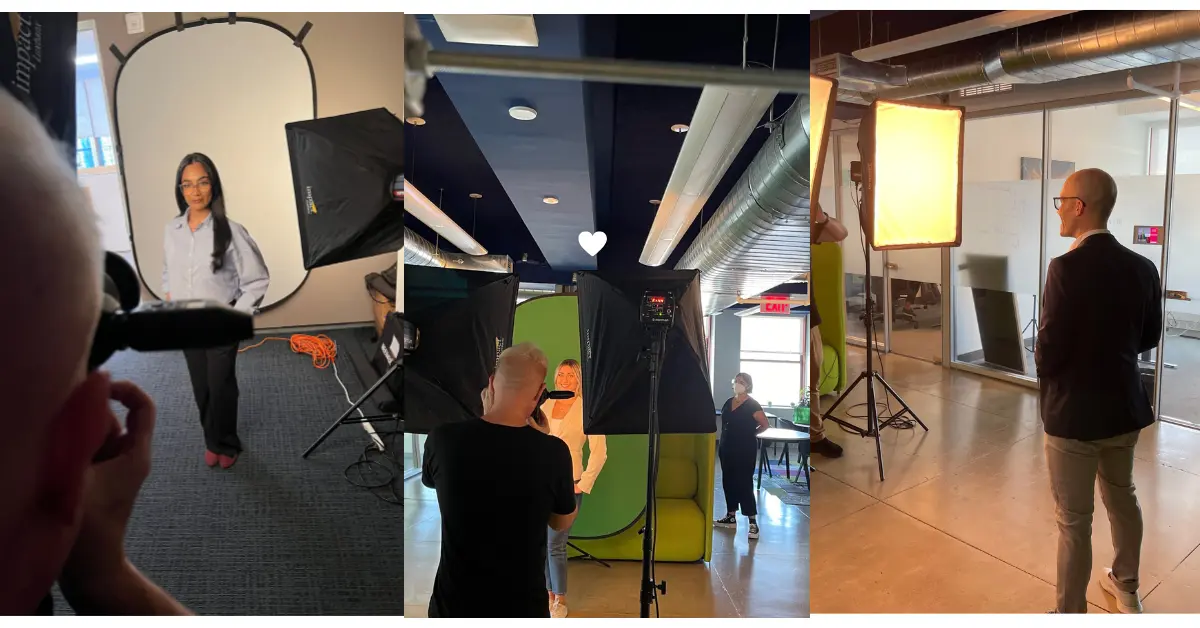
A corporate headshot system built for scale not aesthetics
This project was not a photography assignment.
It came from a financial institution in New York City with over 1,000 employees. The kind of organization where small inconsistencies turn into visible brand risk fast.
At first glance, the request looked simple.
Corporate headshots NYC. Update employee photos. Make things consistent.
That is rarely the real problem.
What this project actually was
This was a large financial institution going through rapid structural change.
- Growth through hiring
- Integration of acquired credit unions
- A new executive leadership mandate
- A full digital and website transformation underway
Each of those changes added people. Systems. And visual inconsistency.
By the time it surfaced, the company did not look like one organization online.
It looked like multiple organizations stitched together.
Why this was not a photography problem
If you treat this as photography, you miss the real issue.
The problem was not image quality.
It was visual fragmentation.
Different headshot styles across departments.
Different lighting approaches.
Different levels of professionalism depending on when someone was hired.
Some employees had studio portraits.
Others had cropped event photos.
Some had nothing at all.
On a company website or LinkedIn page, that inconsistency creates doubt.
And in financial services, doubt is expensive.
People do not always say it out loud. But they feel it.
That is what leadership was reacting to.
What was actually being solved
The real goal was not “better photos.”
It was:
- A unified visual identity across the entire workforce
- A repeatable system for onboarding new employees visually
- A consistent standard that works across web, internal systems, and LinkedIn
- A controlled production process that does not disrupt operations
In other words, this became an enterprise-level visual system problem.
Not a creative project.
The outcome
The solution was a structured corporate headshot system designed for scale.
Not just a shoot.
A full workflow that ensures:
- Every employee looks like part of the same organization
- Leadership and staff feel visually aligned, not separated
- New hires automatically fit the system without redesign
- HR and marketing do not have to reinvent the process each time
The result is a consistent corporate visual identity system that can scale with the organization instead of breaking under it.
2.The Real Business Problem
Not a headshot issue. A visibility and trust issue.
Most companies think they come to a photographer because they need updated corporate headshots.
That was not the case here.
This was a large financial institution in New York with over 1,000 employees. The request for corporate headshots NYC was only the surface layer.
Underneath, there was a much larger operational and brand problem forming quietly across the organization.
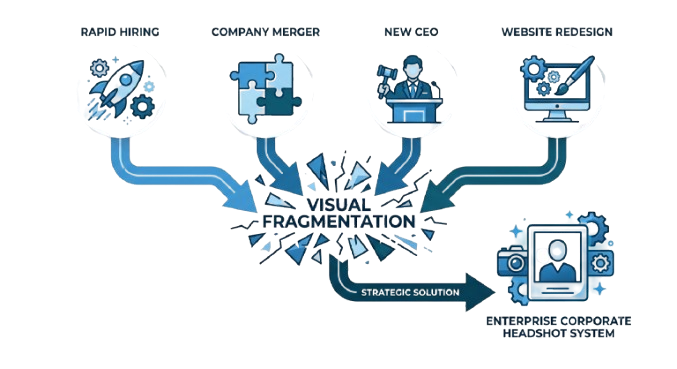
2.1 Organizational Trigger Events
This project did not start from one decision. It built up over time through pressure from multiple directions.
Rapid hiring expansion
The company grew quickly.
New employees were joining continuously across departments. Compliance, customer service, fintech partnerships, risk, and leadership teams.
Every new hire added another inconsistency into the visual system.
No single standard was being enforced at scale.
Multi-organization merger integration
The institution had absorbed smaller regional credit unions.
Each one brought its own culture and its own way of presenting people visually.
Some had professional studio portraits.
Some used informal office photos.
Some had no structured approach at all.
When merged together, nothing matched.
Not intentionally. Just structurally.
New CEO brand modernization mandate
A new CEO came in with a clear directive.
Modernize how the organization is perceived.
Not only in services, but in public-facing identity.
During early brand audits, leadership noticed something simple but uncomfortable.
The people on the website did not look like one company.
That became a quiet but serious concern.
Website redesign and digital transformation
A full digital rebuild was already in progress.
New website. New content structure. New messaging strategy.
But early mockups exposed a problem.
The design looked modern, but the people did not match the level of polish.
That mismatch affects trust more than most teams realize.
Users notice it instantly, even if they cannot explain why.
Employer branding pressure in NYC market
Hiring in New York is competitive.
Banks, fintech companies and startups are all fighting for the same talent.
Candidates do not just evaluate job descriptions.
They evaluate leadership pages. Team pages. LinkedIn presence.
And what they saw here was inconsistent.
That inconsistency quietly weakened employer perception.
2.2 The Hidden Problem
On paper, everything looked normal.
Inside the system, it was not.
Visual fragmentation across departments
There was no single visual standard.
Different departments had different photo styles.
Different lighting. Different framing. Different levels of formality.
It did not feel intentional.
It felt accidental.
And that is what makes it dangerous for a brand.
Inconsistent employee representation across platforms
Employees were showing up differently across systems.
- Website profiles
- LinkedIn headshots
- Internal directories
- Press materials
Some employees looked polished.
Some looked outdated.
Some looked like they belonged to a different company entirely.
That inconsistency weakens brand perception at scale.
Broken trust perception in digital touchpoints
In financial services, trust is fragile.
Small visual inconsistencies create unnecessary doubt.
Not because users consciously analyze photos.
But because the brain registers inconsistency as risk.
If the company looks disorganized visually, people assume some level of operational disorganization too.
Fair or not, that is how perception works.
No standardized identity system for staff imagery
There was no system.
No unified lighting approach.
No consistent cropping rules.
No defined expression style.
No repeatable process for new hires.
So every new batch of employees added more variation instead of reinforcing consistency.
That is where most organizations slowly lose control of their visual identity.
2.3 Why This Became a Business Risk
This was no longer about aesthetics.
It started affecting perception in measurable ways.
Website conversion trust drop
During early testing of the redesigned website, internal teams noticed something important.
Pages with inconsistent or weak staff imagery underperformed.
Not in clicks.
In trust behavior.
Users hesitated more. Engaged less deeply. Converted at lower rates.
Even small visual inconsistencies can interrupt confidence in financial decisions.
LinkedIn and recruitment perception issues
Candidate experience started to show friction.
People were not explicitly rejecting the company because of photos.
But engagement patterns suggested hesitation.
Profile visits did not convert into applications at the expected rate.
Feedback often described the brand as unclear or hard to interpret visually.
That is usually a symptom of inconsistency, not messaging.
Leadership inconsistency in public-facing profiles
Leadership visibility was uneven.
Some executives had strong, consistent portraits.
Others had outdated or informal images.
Some had no proper headshot at all.
For a financial institution, that creates an unintentional hierarchy gap.
It signals internal imbalance, even when none exists.
What this really means
By the time the project reached production, the issue was clear.
This was not a photography upgrade.
It was a trust alignment problem across every digital surface where employees appeared.
And once leadership saw it that way, the solution stopped being about photos.
It became about building a controlled system for visual consistency at enterprise scale.
3.Stakeholders & Internal Complexity Map
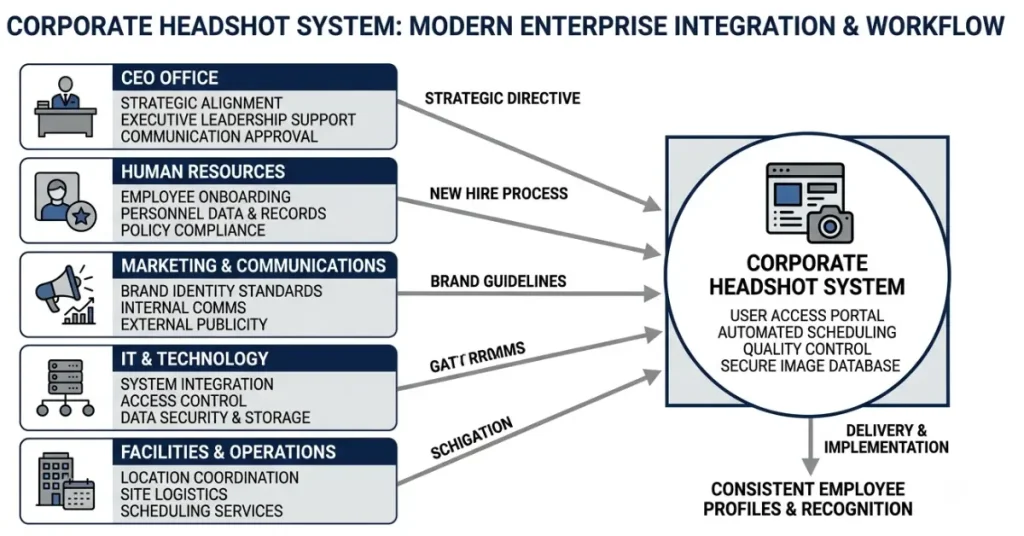
This was not a single-client project. It was a multi-system coordination problem.
In most corporate headshot NYC projects, people assume there is one decision-maker.
That rarely happens in large financial institutions.
In this case, the “client” was actually a network of departments, each with different priorities, timelines, and definitions of success.
Understanding that structure was critical before any photography could even be planned.
3.Stakeholders & Internal Complexity Map
This was not a single-client project. It was a multi-system coordination problem.
In most corporate headshot NYC projects, people assume there is one decision-maker.
That rarely happens in large financial institutions.
In this case, the “client” was actually a network of departments, each with different priorities, timelines, and definitions of success.
Understanding that structure was critical before any photography could even be planned.
3.1 Who Was Involved
HR (employee coordination)
HR was responsible for the people side of the project.
Their focus was practical:
- Who needs to be photographed
- How to schedule hundreds of employees
- How to minimize disruption to daily operations
- How to handle new hires during the process
For HR, success meant smooth execution without employee complaints or workflow interruption.
Not visuals. Not branding. Just operational stability.
Marketing (brand consistency)
Marketing owned the external perception.
Their concern was very different.
- Website appearance
- LinkedIn presence
- Brand consistency across all touchpoints
- Alignment with the new digital identity
They were focused on how the organization looks to the outside world.
If HR cares about people flow, Marketing cares about perception flow.
Those are not always aligned.
IT / Web (technical image requirements)
IT and web teams brought constraints that often appear late in these projects.
- Image dimensions
- File formats
- Compression requirements
- CMS compatibility
- Page load performance
They were not thinking about photography at all.
They were thinking about system performance and implementation.
This is often where creative plans break if not considered early.
Facilities (space logistics)
Facilities handled physical reality.
- Room availability
- Lighting conditions in offices
- Setup space for equipment
- Employee movement inside the building
- Noise and disruption control
They were the difference between a smooth shoot and a chaotic one.
Most photography issues at scale are actually space issues, not camera issues.
CEO Office (executive oversight)
The CEO office was not involved in daily execution.
But they had final visibility.
Especially for leadership headshots and public-facing materials.
Their concern was simple but high stakes:
Does this represent the organization at the level we want externally?
That question quietly influences every decision downstream.
3.2 The Coordination Problem
Once all stakeholders were identified, the real challenge became obvious.
There was no unified system connecting them.
No single owner of visual identity
No department fully owned the entire visual output.
- HR owned people
- Marketing owned brand
- IT owned systems
- Facilities owned space
- Leadership owned approval
But no one owned the full experience end to end.
That gap creates friction in every decision.
Conflicting priorities across departments
Each department had a valid but different definition of success.
- HR wanted minimal disruption
- Marketing wanted visual consistency
- IT wanted technical compliance
- Facilities wanted logistical simplicity
- Leadership wanted strong brand perception
Individually, all reasonable.
Together, they create tension.
Without alignment, every decision becomes a negotiation.
Even small ones like timing, setup, or approval flow.
Lack of shared documentation or standard
There was no single source of truth.
No unified guideline for:
- What a “correct” headshot looks like
- How lighting should be handled
- What expression style fits the brand
- How images should be formatted for different platforms
So each group operated based on assumptions.
And assumptions vary by department.
That is where inconsistency starts.
3.3 Hidden Role of Photographer
This is the part most people outside the industry do not see.
The photographer is not just executing images.
In enterprise environments, the photographer becomes a coordination layer.
Became a system translator between departments
Each stakeholder spoke a different operational language.
- HR spoke in schedules and headcount
- Marketing spoke in brand perception
- IT spoke in constraints and formats
- Facilities spoke in physical logistics
- Leadership spoke in outcomes and risk
None of these naturally align.
So the role shifted.
Not officially. But practically.
The photographer became the translator between systems that were not designed to talk to each other.
Reduced internal coordination friction
Instead of every department negotiating separately, the process became centralized through one production system.
That changed everything.
- Fewer conflicting instructions
- Faster decision-making
- Clearer execution path
- Less back-and-forth between teams
The goal was no longer just to take headshots.
It was to remove operational friction from the system.
Because in large organizations, friction is what slows projects down more than complexity itself.
4.The Hidden Brief
What clients actually mean versus what they say out loud
In large organizations, especially in financial institutions in NYC, the first brief is never the real brief.
What gets written in emails is simple.
What sits underneath is operational, emotional, and often unspoken.
This project was no different.
On the surface, it was a request for corporate headshots NYC.
Underneath, it was a request for control, consistency, and predictability at scale.
What they couldn’t articulate directly
These were not official requirements.
But they were the real decision drivers behind the project.
We don’t know what good looks like, but we’ll know when we see it
This is one of the most common statements in enterprise visual projects.
It sounds vague, but it is actually a risk signal.
It means:
- There is no internal visual standard
- There is no agreed reference point
- Approval is subjective and reactive
In that environment, every sample image becomes a negotiation.
Not a decision.
That slows everything down unless the system is designed to absorb uncertainty.
We need consistency at scale without disrupting operations.
This is where most corporate headshot projects fail.
Because scale always conflicts with business-as-usual.
In this case, employees were not being pulled out of work for a creative shoot.
They still had jobs to do.
Meetings. Calls. Deadlines.
So the system had to work around reality, not replace it.
That means:
- Fast turnaround per employee
- Minimal downtime
- Predictable scheduling
- No disruption to daily workflow
Consistency was not just a visual requirement.
It was an operational constraint.
We cannot create chaos internally.
This is not about photography.
This is about internal perception.
Large organizations are sensitive to disruption.
Especially during:
- Website redesigns
- Brand updates
- Leadership transitions
- Hiring expansions
Even a well-intentioned project can create internal frustration if it feels disorganized.
So the real requirement was simple:
The process had to feel controlled.
Not improvised.
Not experimental.
Controlled.
Leadership must match staff visually (no hierarchy imbalance).
This is a detail most people miss.
But it matters in corporate environments.
If executives look overly polished while employees look inconsistent, it creates a visual hierarchy problem.
It signals separation instead of unity.
On the other hand, if leadership looks underproduced, it weakens authority.
So the system had to balance both ends.
- Executives: authoritative but accessible
- Staff: consistent and aligned with brand tone
- No visual disconnect between levels
That balance is harder than it sounds in large organizations.
This must feel effortless for employees.
This is the emotional requirement underneath the logistics.
Most employees are not comfortable being photographed.
They are thinking about:
- How they look
- How long it will take
- Whether they are doing it “right”
- Whether they are holding up their team
If the process feels slow or unclear, anxiety increases.
And that shows up in the images.
So the system had to remove friction.
Not just technically, but emotionally.
Simple instructions.
Clear flow.
No confusion.
No waiting uncertainty.
Key insight statement
The client was not buying photography.
They were buying operational certainty at scale.
Not just good images.
Not just consistency.
But a system that could run across hundreds of employees, multiple departments, and tight timelines without breaking internal operations or creating chaos.
That is what defines enterprise corporate photography.
Everything else is execution detail.
5.The Corporate Headshot System (Core Framework)
A structured system built for scale, not improvisation
Most corporate photography breaks down at scale because it relies on creative execution instead of repeatable systems.
That works for small teams.
It fails quickly in large organizations.
For this NYC financial institution project, the only way to maintain consistency across 1,000+ employees was to design a structured production system.
Not a shoot plan.
A system.
5.1 System Overview
A 9-phase production system designed for enterprise consistency
This workflow is built to handle complexity without losing control.
Each phase has a specific role in reducing uncertainty and maintaining visual consistency across every employee.
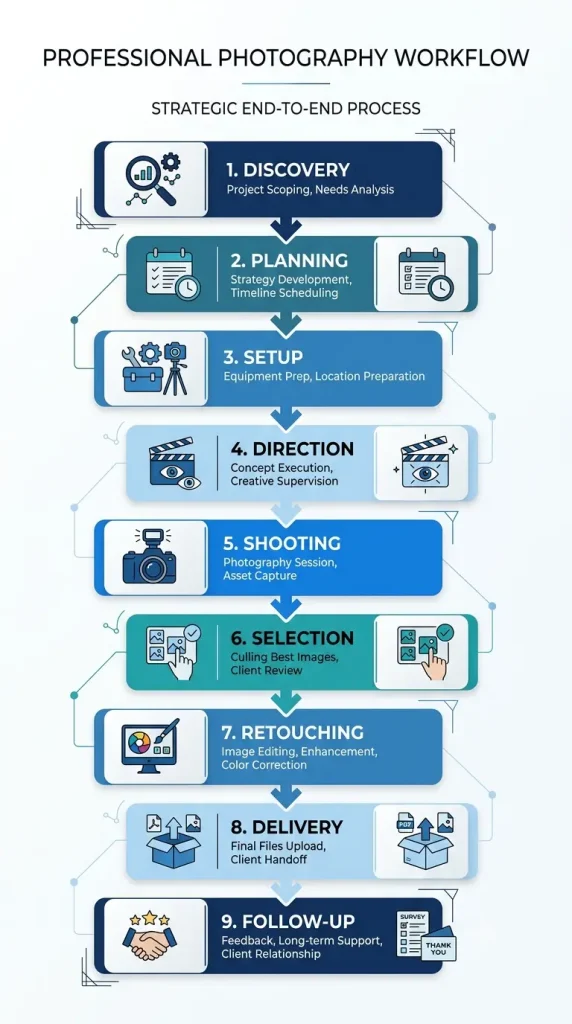
1. Discovery
This is where the system starts.
Not with photography decisions.
With business understanding.
At this stage, the focus is:
- Why the organization needs new headshots
- Where the images will be used
- Who needs to be photographed
- What the brand is trying to communicate visually
This phase prevents the most common mistake in corporate headshot NYC projects.
Jumping straight into execution without understanding purpose.
2. Planning
This is where structure replaces assumptions.
Planning defines how the system will operate in real conditions.
It includes:
- Visual direction (lighting, tone, background style)
- Employee flow (how people move through the process)
- Time allocation per person
- Location feasibility inside real office environments
At this stage, the goal is simple.
Remove uncertainty before the first person arrives.
3. Setup
This is the physical translation of the plan.
The environment is built to behave consistently.
That includes:
- Fixed camera position
- Controlled lighting system
- Defined portrait zone
- Clear movement path for employees
Setup is where chaos gets removed from the equation.
If setup is wrong, everything after becomes inconsistent.
4. Direction
This is the human layer of the system.
Most people think this is about posing.
It is not.
It is about reducing discomfort and guiding natural expression under pressure.
Direction includes:
- Simple communication
- Clear emotional cues
- Posture adjustments
- Eye-line control
The goal is not to “pose” people.
The goal is to help them look natural in an unnatural situation.
5. Shooting
This is where the system produces output.
Not randomly.
In controlled sequences.
Each person is guided through:
- Base pose setup
- Expression variations
- Small posture adjustments
- Multiple usable frames
The key is consistency under repetition.
Hundreds of employees must look like they belong to the same organization.
Not like they were photographed on different days by different people.
6. Selection
This is where technical quality is not enough.
Selection is based on alignment with the system.
Each image is evaluated for:
- Technical correctness
- Expression quality
- Brand consistency
- Cohesion with the full set
A strong individual image is not enough.
It must work as part of a unified system.
7. Retouching
This phase is often misunderstood.
It is not about changing appearance.
It is about removing distractions.
Retouching focuses on:
- Temporary skin imperfections
- Minor visual distractions
- Color and tonal consistency
- Clean, professional finish
What is not changed matters more:
- Identity stays intact
- Facial structure is preserved
- Natural texture remains
If retouching is noticeable, it has gone too far.
8. Delivery
This is where the system becomes usable.
Not just delivered.
Organized for real business use.
Delivery includes:
- Structured file naming
- Organized folders by employee or department
- Web and print versions
- Platform-specific formats (LinkedIn, website, internal systems)
The goal is simple.
No confusion for HR or marketing teams after delivery.
They should not have to guess which file to use.
9. Follow-up
This is where most photographers stop.
But enterprise work does not end at delivery.
Follow-up ensures:
- Files are being used correctly
- The system is working across platforms
- Future hires can be integrated consistently
- The visual standard remains stable over time
This is what turns a one-time shoot into a long-term system.
Why this system matters
Corporate headshot work at scale is not about taking better photos.
It is about removing unpredictability.
When you eliminate unpredictability across discovery, planning, execution and delivery. The result is consistency that holds up across hundreds or thousands of employees.
That is the difference between a photoshoot and a production system.
6.Discovery Phase (Identity + Risk Diagnosis System)
This is not intake. It is system diagnosis.
Most people think discovery is about collecting requirements.
In enterprise corporate headshot NYC projects, that approach fails quickly.
Discovery is not about asking what the client wants.
It is about identifying how visual inconsistency is already affecting the organization.
This is where the system begins.
6.1 Data Collected
Building a complete operational picture before any photography decisions
At this stage, I am not thinking about cameras, lighting, or style.
I am mapping how the organization actually functions visually.
Company structure and size
The first step is understanding scale.
- Total employee count
- Growth rate over time
- Organizational hierarchy
- Number of departments
A 50-person company behaves completely differently from a 1,000+ employee financial institution.
Scale changes everything.
Especially consistency requirements.
Departments and locations
Next is distribution.
Where people actually are matters as much as how many there are.
I look at:
- Headquarters structure
- Regional offices
- Remote or hybrid teams
- Travel between locations
This defines how many setups are required and how the system will be deployed in real conditions.
If you ignore location complexity, the entire shoot becomes inefficient fast.
Usage across platforms
This is where most clients underestimate complexity.
I map where the images will actually appear:
- Company website (team pages, leadership pages)
- LinkedIn profiles (individual and company pages)
- Internal systems (directories, HR platforms)
- Press and media kits
- Recruitment and employer branding assets
Each platform has different technical and visual expectations.
A headshot that works on LinkedIn may fail on a website leadership page.
So usage defines structure.
Not preference.
Hiring volume
This tells me how the system must scale over time.
- One-time update
- Ongoing hiring pipeline
- Seasonal onboarding spikes
- Department-level hiring cycles
High hiring volume means the system cannot be static.
It must be repeatable without degradation in quality.
Otherwise consistency breaks within months.
Leadership visibility requirements
Executives are not just another group.
They define perception.
I assess:
- How visible leadership is externally
- Whether executives need multiple image types
- Press and investor-facing requirements
- Internal vs external usage differences
In financial institutions, leadership imagery carries disproportionate weight.
If executive photos feel disconnected from staff, the entire brand feels split.
6.2 Brand Interpretation
Translating data into visual direction and risk understanding
Once the operational data is clear, I shift to interpretation.
This is where the system moves from logistics to perception design.
Trust vs innovation vs authority positioning
Every organization sits somewhere on this spectrum.
In this case, a financial institution cannot afford ambiguity.
I look at:
- Is the brand primarily trust-driven?
- Is it trying to appear modern and innovative?
- Does it need to reinforce authority and stability?
Most companies say “all three.”
In reality, one always dominates.
The job is to identify it clearly.
Because visual identity must reinforce one primary perception, not dilute across three.
Competitor visual benchmarking
This is not about copying competitors.
It is about understanding category standards.
I analyze:
- Major banks and credit unions
- Fintech companies
- Regional competitors in NYC
- Recruitment-facing employer branding
The goal is to answer a simple question:
What does “normal” look like in this market, and where is this organization positioned against it?
If you fall below baseline, you lose trust.
If you exceed it inconsistently, you lose coherence.
Audience perception mapping
This is the most important part of discovery.
Because the images are not for internal approval.
They are for external perception.
I identify:
- Clients viewing leadership pages
- Potential employees on LinkedIn
- Press and media outlets
- Existing members or customers
Then I ask a simple question:
What do these people need to believe in less than two seconds?
Usually the answer is not technical.
It is emotional.
- “This looks trustworthy”
- “This feels stable”
- “This seems professional and organized”
If the images fail that first impression test, nothing else matters.
What this phase actually produces
Discovery is not documentation.
It is alignment.
By the end of this phase, I am not guessing anymore.
I have clarity on:
- What the organization is trying to signal visually
- Where inconsistency currently exists
- What the system must fix at scale
- What risks will appear if nothing changes
Most photography projects skip this step.
That is why they struggle when scale enters the picture.
Because without diagnosis, you are just taking photos.
Not solving a system problem.
6.Discovery Phase (Identity + Risk Diagnosis System)
This is not intake. It is system diagnosis.
Most people think discovery is about collecting requirements.
In enterprise corporate headshot NYC projects, that approach fails quickly.
Discovery is not about asking what the client wants.
It is about identifying how visual inconsistency is already affecting the organization.
This is where the system begins.
6.1 Data Collected
Building a complete operational picture before any photography decisions
At this stage, I am not thinking about cameras, lighting, or style.
I am mapping how the organization actually functions visually.
Company structure and size
The first step is understanding scale.
- Total employee count
- Growth rate over time
- Organizational hierarchy
- Number of departments
A 50-person company behaves completely differently from a 1,000+ employee financial institution.
Scale changes everything.
Especially consistency requirements.
Departments and locations
Next is distribution.
Where people actually are matters as much as how many there are.
I look at:
- Headquarters structure
- Regional offices
- Remote or hybrid teams
- Travel between locations
This defines how many setups are required and how the system will be deployed in real conditions.
If you ignore location complexity, the entire shoot becomes inefficient fast.
Usage across platforms
This is where most clients underestimate complexity.
I map where the images will actually appear:
- Company website (team pages, leadership pages)
- LinkedIn profiles (individual and company pages)
- Internal systems (directories, HR platforms)
- Press and media kits
- Recruitment and employer branding assets
Each platform has different technical and visual expectations.
A headshot that works on LinkedIn may fail on a website leadership page.
So usage defines structure.
Not preference.
Hiring volume
This tells me how the system must scale over time.
- One-time update
- Ongoing hiring pipeline
- Seasonal onboarding spikes
- Department-level hiring cycles
High hiring volume means the system cannot be static.
It must be repeatable without degradation in quality.
Otherwise consistency breaks within months.
Leadership visibility requirements
Executives are not just another group.
They define perception.
I assess:
- How visible leadership is externally
- Whether executives need multiple image types
- Press and investor-facing requirements
- Internal vs external usage differences
In financial institutions, leadership imagery carries disproportionate weight.
If executive photos feel disconnected from staff, the entire brand feels split.
6.2 Brand Interpretation
Translating data into visual direction and risk understanding
Once the operational data is clear, I shift to interpretation.
This is where the system moves from logistics to perception design.
Trust vs innovation vs authority positioning
Every organization sits somewhere on this spectrum.
In this case, a financial institution cannot afford ambiguity.
I look at:
- Is the brand primarily trust-driven?
- Is it trying to appear modern and innovative?
- Does it need to reinforce authority and stability?
Most companies say “all three.”
In reality, one always dominates.
The job is to identify it clearly.
Because visual identity must reinforce one primary perception, not dilute across three.
Competitor visual benchmarking
This is not about copying competitors.
It is about understanding category standards.
I analyze:
- Major banks and credit unions
- Fintech companies
- Regional competitors in NYC
- Recruitment-facing employer branding
The goal is to answer a simple question:
What does “normal” look like in this market, and where is this organization positioned against it?
If you fall below baseline, you lose trust.
If you exceed it inconsistently, you lose coherence.
Audience perception mapping
This is the most important part of discovery.
Because the images are not for internal approval.
They are for external perception.
I identify:
- Clients viewing leadership pages
- Potential employees on LinkedIn
- Press and media outlets
- Existing members or customers
Then I ask a simple question:
What do these people need to believe in less than two seconds?
Usually the answer is not technical.
It is emotional.
- “This looks trustworthy”
- “This feels stable”
- “This seems professional and organized”
If the images fail that first impression test, nothing else matters.
What this phase actually produces
Discovery is not documentation.
It is alignment.
By the end of this phase, I am not guessing anymore.
I have clarity on:
- What the organization is trying to signal visually
- Where inconsistency currently exists
- What the system must fix at scale
- What risks will appear if nothing changes
Most photography projects skip this step.
That is why they struggle when scale enters the picture.
Because without diagnosis, you are just taking photos.
Not solving a system problem.
6.3 Key Discovery Questions Framework
These questions are not creative prompts. They are control filters.
Most corporate headshot projects start with logistics.
When you do that, you miss the real problem.
In enterprise environments, especially in financial institutions, the right questions are not about photography at all.
They are about perception, trust, and usage.
These three questions usually reveal more than any brief or email chain.
What do you want people to feel?
This is the foundation question.
Not what they want people to see.
What they want people to feel.
Because in corporate photography, feeling drives trust faster than detail.
In practice, clients will often answer with vague words:
- professional
- modern
- friendly
- confident
Those words are not useful yet.
So I push further.
Who are “people” in this sentence?
Clients, employees, investors, candidates.
Each group requires a different emotional outcome.
If this is not clarified, the system produces inconsistent visual messaging later.
Who needs to trust this image?
This question shifts the conversation from aesthetics to audience.
Most companies initially think everyone is the audience.
That is not accurate.
Different images serve different trust relationships:
- A recruiter evaluating leadership credibility
- A customer assessing legitimacy on a website
- A candidate judging company culture on LinkedIn
- A partner reviewing leadership in a press feature
Each group reads visual signals differently.
In financial services, trust is not general.
It is segmented.
So the image must be designed with a specific trust relationship in mind.
Where will this image appear?
This is the most operationally important question.
Because context changes everything.
A headshot is not one asset.
It is multiple assets depending on where it is used.
Typical placements include:
- Company website leadership pages
- Employee profile directories
- LinkedIn profiles
- Press releases and media kits
- Internal HR systems
- Recruitment materials
Each platform changes the requirements:
- Crop ratios
- Background visibility
- Expression intensity
- File size and resolution
If you ignore usage context, you end up with beautiful images that fail in real deployment.
This is where most corporate photography breaks down.
Not during shooting.
During application.
6.4 Output
What this phase actually produces before any photography begins
Discovery is only valuable if it creates clarity that survives execution.
At the end of this phase, I do not move forward with assumptions.
I move forward with defined structure.
Visual direction definition
This is the first tangible output.
It translates abstract brand goals into a usable visual system.
It defines:
- Lighting style (controlled, soft, high-contrast, etc.)
- Expression direction (approachable, authoritative, neutral confidence)
- Background approach (clean studio, environmental office, hybrid)
- Overall tone (trust-first, modern, executive, or balanced)
This becomes the reference point for every decision later in the project.
Without this, consistency at scale is impossible.
Stakeholder alignment map
Large organizations do not operate with one voice.
They operate with multiple priorities that often conflict.
This map clarifies:
- Who approves what
- Who influences brand direction
- Who controls logistics
- Who handles execution coordination
- Who has final sign-off authority
It also exposes gaps early.
Especially where no one officially owns the visual identity system.
Once this is visible, coordination becomes structured instead of reactive.
Risk points identified
This is where operational failure risks are surfaced before production starts.
Common risks include:
- Lack of space for setup inside offices
- Employee scheduling conflicts during peak work hours
- Inconsistent lighting conditions across locations
- Undefined approval workflows between departments
- High variability in employee readiness or expectations
These are not minor issues.
In enterprise shoots, these are the points where projects slow down or lose consistency.
By identifying them early, the system is designed around reality instead of assumptions.
What this phase really does
Discovery is not about gathering information.
It is about reducing uncertainty.
Once these outputs are defined, the project stops being theoretical.
It becomes operational.
At that point, execution is no longer guesswork.
It is a controlled system built on clear constraints, clear intent, and clear risk awareness.
7.Planning Phase(Production Architecture Design)
This is where strategy becomes a working system
Most corporate headshot NYC projects fail at scale because planning is treated as scheduling.
That is too small.
Planning is not logistics.
It is production architecture.
Once discovery defines what the organization needs, planning defines how that reality is executed across hundreds of people without breaking consistency.
This is where control is built into the system.
7.1 Visual System Design
Turning brand intent into a repeatable visual standard
At this stage, the goal is not creativity.
It is repeatability.
Every decision must produce the same result across employee number 1 and employee number 1,000.
Lighting style (consistent corporate schema)
Lighting is the foundation of consistency.
If lighting changes, everything changes.
So I define a single controlled lighting schema that applies to every subject.
In enterprise financial environments, this usually means:
- Soft, directional key light
- Controlled shadow depth
- Neutral color balance
- Predictable falloff
The goal is not dramatic lighting.
It is stable lighting.
Something that holds up across different skin tones, face shapes, and departments without variation.
Consistency in lighting is what makes a team look like one organization instead of individual portraits.
Background selection strategy
Background is not aesthetic decoration.
It is brand structure.
I choose backgrounds based on how the company wants to be perceived externally.
Typical approaches include:
- Clean neutral backgrounds for trust and clarity
- Subtle environmental office backgrounds for authenticity
- Controlled branded tones when identity needs reinforcement
What matters most is not the background itself.
It is whether it scales across hundreds of employees without visual drift.
If the background cannot remain consistent, the system fails at the team level.
Expression guidelines
Expression is where most inconsistency appears.
People naturally express themselves differently under pressure.
So I standardize expression direction before shooting begins.
This includes:
- Confidence without stiffness
- Approachability without over-smiling
- Neutral professionalism for general use cases
- Leadership presence for executives
The key is control without forcing artificial emotion.
Employees should look like themselves on their best professional day.
Not like they are performing for a camera.
Wardrobe guidance system
Wardrobe is often underestimated in corporate photography projects.
But it directly impacts consistency more than most technical factors.
I define simple guidelines:
- Avoid distracting patterns
- Stick to neutral or brand-aligned tones
- Maintain contrast control between subject and background
- Keep clothing consistent across departments when possible
The goal is not fashion control.
It is visual harmony across a large group.
If wardrobe varies too widely, even perfect lighting cannot fix inconsistency.
7.2 Production Flow Design
Designing how people move through the system without disruption
This is where planning becomes operational.
A corporate shoot is not a series of portraits.
It is a high-volume human flow system operating inside a live business environment.
Time-per-person standardization
Every employee must pass through the same system.
So time becomes a controlled variable.
I define a consistent time window per person based on:
- Expression complexity
- Number of usable variations needed
- Organizational scale
In most enterprise setups, the goal is efficiency without pressure.
Enough time to capture quality.
Not so much time that operations slow down.
Consistency here prevents bottlenecks and protects workflow stability.
Employee scheduling logic
Scheduling is not random.
It is structured around business reality.
I coordinate with HR and internal teams to:
- Minimize disruption to peak working hours
- Group employees by department for flow efficiency
- Reduce movement across office floors
- Maintain predictable daily shoot cycles
The system must adapt to the organization’s rhythm.
Not the other way around.
If scheduling is unclear, the entire shoot becomes chaotic within hours.
Throughput optimization (hundreds of employees)
When volume increases, complexity increases non-linearly.
It is not just more people.
It is more risk points.
To maintain throughput:
- Setup remains fixed
- Lighting does not change between individuals
- Workflow steps are identical for every person
- Movement is controlled and predictable
The goal is not speed alone.
It is stable repetition without quality loss.
That is what allows hundreds of employees to be photographed without breaking consistency.
7.3 Risk Management
Preventing operational failure before it happens
In large corporate environments, most issues are not creative.
They are operational.
Planning is where those risks are neutralized in advance.
Space constraints
Office environments are not designed for production.
They are designed for work.
So space becomes one of the biggest constraints.
I evaluate:
- Room size and layout
- Background flexibility
- Employee waiting areas
- Equipment placement limitations
If space is not correctly assessed, even a good lighting setup becomes unstable.
This is why pre-location planning is critical.
Lighting variability control
Lighting is the most sensitive part of the system.
Small changes create large inconsistencies.
To prevent this, I lock:
- Light position
- Intensity levels
- Color temperature
- Subject distance
Even minor adjustments between employees can create visible inconsistency across a team page.
The goal is zero drift across the entire shoot.
Employee delay handling
In real corporate environments, delays are normal.
Meetings run over.
Departments shift priorities.
People arrive late or early.
So the system must absorb unpredictability.
I build flexibility into the schedule so that:
- Small delays do not affect output quality
- Flow continues even when timing shifts
- No backlog builds up at the shooting station
A stable system expects disruption.
It does not break because of it.
Approval bottlenecks
Approval chains are one of the biggest hidden risks in corporate photography.
Multiple stakeholders often need to sign off:
- HR
- Marketing
- Leadership
- IT or brand teams
If approval is not aligned early, feedback loops can slow down delivery significantly.
So I define decision pathways before production begins.
This reduces confusion later and keeps the project moving.
What this phase actually achieves
Planning is where uncertainty is removed from execution.
By the time production starts, nothing is improvised.
Everything is structured:
- How people move
- How images are created
- How consistency is maintained
- How risks are absorbed
At this point, the project is no longer a shoot.
It is a controlled production system operating inside a live organization.
8.Setup Phase(Controlled Environment System)
This is where planning becomes a working production space
Most corporate headshot NYC projects start shooting too early.
That is a mistake.
Setup is where consistency is actually built.
Not in editing.
Not in planning documents.
In the physical environment before the first employee steps in front of the camera.
If this phase is wrong, everything after becomes unstable.
8.1 Location Engineering
Turning a real office into a controlled production environment
Corporate photography rarely happens in ideal studio conditions.
It happens inside offices, conference rooms, and shared workspaces.
So the environment has to be engineered, not assumed.
Portrait zone creation
The first step is defining a fixed portrait zone.
This is the exact physical space where every employee will be photographed.
It includes:
- Camera position
- Subject standing position
- Distance markers
- Framing boundaries
This zone removes randomness.
If every person stands in a slightly different place, consistency breaks immediately.
The portrait zone ensures every frame starts from the same geometry.
That is what makes large-scale consistency possible.
Background separation design
Background is not just what appears behind the subject.
It is a controlled visual layer.
I design separation between subject and background so that:
- The subject stands clearly forward
- The background does not distract
- Depth remains consistent across all employees
In office environments, this is critical.
Walls, glass, and ambient clutter can easily create inconsistency if not controlled.
So I manage distance, angle, and lighting falloff carefully.
The goal is simple.
Every person should look like they belong to the same visual system, not random office conditions.
Traffic flow setup
Once the portrait zone is defined, movement becomes the next priority.
Corporate shoots fail when people do not know where to go or what happens next.
So I structure physical flow:
- Entry point into shooting area
- Waiting zone for employees
- Transition path to camera position
- Exit path after capture
This prevents congestion and confusion.
It also reduces employee anxiety.
When people understand the flow, they relax faster.
And relaxed people photograph better.
8.2 Lighting System Lock
Locking the visual system before production starts
Lighting is the most sensitive variable in corporate photography.
If it changes, consistency breaks instantly.
So this phase is about locking the system completely.
Fixed lighting geometry
Once lighting is set, it does not move.
Not between departments.
Not between employees.
Not during the session.
I define:
- Light position
- Angle relative to subject
- Height
- Distance
- Modifier placement
This creates a repeatable geometry that produces identical visual behavior for every person.
In large organizations, this is what keeps a team page visually unified.
Without it, every portrait becomes a different visual language.
Controlled exposure system
Exposure must remain stable across the entire shoot.
If brightness shifts between employees, the final set looks inconsistent even if everything else is correct.
So I lock:
- Exposure settings
- White balance
- Contrast behavior
- Camera position relative to light
This ensures that employee number 1 and employee number 200 look like they were photographed under the same conditions.
Not similar conditions.
The same conditions.
Consistency calibration
Before any real shooting begins, I fine-tune the system.
This is where small adjustments matter.
I check:
- Skin tone accuracy
- Background neutrality
- Shadow softness
- Highlight control
- Overall color consistency
The goal is not perfection for one image.
It is stability across hundreds of images.
Once calibration is complete, the system should not need adjustment during production.
8.3 Pre-Production Testing
The final safety check before real production begins
This step prevents expensive mistakes.
Most inconsistencies in corporate photography happen because testing was skipped or rushed.
I do not start with a real employee.
I test the system first.
Assistant test subject
Before any employee is photographed, I use a stand-in.
This could be:
- An assistant
- A team member
- Anyone available on-site
The purpose is not image quality.
It is system validation.
I check how the entire setup performs with a human subject in place.
This reveals problems that are not visible in empty setup conditions.
Lighting validation before first employee
With the test subject in position, I validate the full system.
I look at:
- How light interacts with the face
- Whether shadows behave consistently
- If background separation holds
- Whether framing remains stable
- If exposure translates correctly in real conditions
This is the final correction point.
If something is off, it is fixed before production starts.
Not during.
Not after.
Before.
What this phase ensures
Setup is where uncertainty is removed from the physical environment.
By the end of this phase:
- The portrait zone is fixed
- Lighting is locked
- Movement flow is defined
- The system is tested under real conditions
At this point, the environment is no longer flexible.
It is controlled.
And that control is what allows hundreds of employees to be photographed without variation, confusion, or breakdown in consistency.
9.Direction Phase(Psychological Expression System)
This is where technical setup becomes human output
At this stage, everything is ready.
Lighting is locked.
Camera position is fixed.
Workflow is stable.
But none of that matters if the person in front of the camera looks tense, disconnected, or unnatural.
Direction is where corporate headshot photography actually succeeds or fails.
Not because of technique.
Because of psychology.
9.1 Anxiety Reduction System
Removing pressure before giving any instructions
Most people assume they are bad at photos.
That assumption creates tension before the first frame is even taken.
So my first job is not direction.
It is removal of uncertainty.
Conversational entry approach
I never start with camera instructions.
That creates pressure immediately.
Instead, I enter the conversation normally.
Simple interaction.
Human tone.
No technical language.
The goal is to reset their mental state from “I am being photographed” to “I am talking to a person.”
Because natural expressions only appear when people stop performing.
Removal of posing uncertainty
The biggest source of awkward headshots is not lighting or camera settings.
It is uncertainty.
People do not know:
- Where to look
- What to do with their hands
- How serious they should be
- Whether they are doing it right
So I remove that completely.
I make it clear:
You do not need to pose.
You only need to respond.
That single shift eliminates most tension instantly.
Guided confidence building
Confidence is not forced.
It is built through small, controlled feedback.
After each frame, I adjust with simple language:
- Slight shift here
- Relax the shoulders
- Good, stay there
- That expression works
No overload.
No technical breakdown.
Just clarity.
People become confident when they stop guessing.
9.2 Expression Engineering
Turning brand intent into controlled human expression
At this level, expression is not random.
It is designed based on business need.
Different roles require different emotional signals.
Not different personalities.
Different signals.
Leadership expression cues
Leadership does not mean intensity.
It means stability.
For executive portraits, I guide:
- Calm eye contact
- Controlled facial tension
- Slight reduction in unnecessary movement
- Grounded posture
The goal is not dominance.
It is credibility under pressure.
A leadership expression should feel steady, not performative.
Approachability cues
For team members and client-facing roles, the expression shifts.
Here the focus is:
- Softened facial tension
- Slight natural smile
- Relaxed jaw and shoulders
- Open posture
Approachability is not about smiling more.
It is about removing resistance in the face.
If the expression feels forced, trust drops immediately.
Trust-based micro direction
Trust is built in micro adjustments.
Not big poses.
Small corrections like:
- Chin angle slightly forward
- Eyes aligned with lens, not above it
- Shoulder relaxation before shutter
- Breath timing before capture
These micro directions control how believable the image feels.
People do not consciously see them.
But they feel them instantly.
9.3 Posture + Eye System
Where physical alignment creates emotional clarity
Expression is incomplete without posture and eye control.
Most corporate headshots fail here.
The face looks fine.
But the body tells a different story.
Posture micro-adjustments
Posture is not about standing straight.
That usually creates stiffness.
Instead, I work in small adjustments:
- Slight forward chest alignment
- Shoulder drop for relaxation
- Subtle torso rotation for depth
- Weight balance correction on feet
These changes create presence without tension.
A strong posture should not look staged.
It should look natural but intentional.
Eye-line emotional control
Eyes determine whether an image connects or feels empty.
I control eye direction carefully:
- Direct eye contact for confidence and clarity
- Slight softening for approachability
- Focused gaze for leadership intent
The key is not just where the eyes look.
It is how they engage.
Empty eyes kill trust instantly.
Engaged eyes create instant credibility.
Natural expression generation
The best expressions are not instructed.
They are triggered.
So instead of asking for smiles or poses, I use prompts that generate natural reactions:
- Think of someone you work well with
- Imagine explaining your role to a new client
- Stay in that thought for a moment
Then I capture the moment between thinking and reacting.
That is where natural expression lives.
Not in forced instruction.
Not in rigid posing.
In transitional human behavior.
What this phase actually delivers
Direction is not about taking control of the person.
It is about removing uncertainty so the person can perform naturally without realizing they are performing.
By the end of this phase:
- Anxiety is reduced
- Expression is aligned with role and brand
- Posture is stable but natural
- Eye contact feels intentional, not forced
At this point, the subject is no longer guessing.
They are simply responding.
And that is where consistent, high-trust corporate headshots actually come from.
10.Shooting Phase(High-Throughput Capture System)
This is where the system becomes execution
By this stage, everything has already been decided.
Lighting is locked.
Environment is stable.
Direction is calibrated.
So shooting is not exploration anymore.
It is controlled repetition with human variation inside a fixed system.
That distinction matters in large corporate headshot NYC projects.
Because scale only works when variability is controlled, not eliminated.
10.1 Capture Methodology
Turning human variation into structured output
Every person behaves differently in front of a camera.
The system does not fight that.
It contains it.
Base pose establishment
The first step with every subject is not expression.
It is structure.
I establish a base pose that aligns:
- Head position
- Shoulder alignment
- Body angle
- Eye direction
This becomes the anchor point.
Without a stable base pose, everything else becomes inconsistent later.
So I do not rush this step.
Even at scale.
Because consistency starts here.
Not in editing.
Controlled variation sampling
Once the base is stable, I introduce variation in a controlled way.
Not random movement.
Not experimentation.
Structured variation.
I guide small changes like:
- Slight head tilt adjustments
- Subtle shoulder relaxation
- Minimal angle shifts toward camera
- Micro expression changes
Each variation is intentional.
The goal is not more images.
The goal is usable differences between images.
So selection becomes easy later.
Expression sequence system
Expression is not captured randomly.
It follows a sequence.
A predictable emotional progression:
- Neutral professional baseline
- Controlled confidence
- Approachable variation
- Natural smile or soft expression
This sequence allows the subject to settle into authenticity.
Most people cannot hold one expression for long.
So I use timing, not pressure.
I capture between transitions, not during forced poses.
That is where real expression appears.
10.2 Output Strategy
Structured image production instead of image quantity
Corporate photography is not about volume.
It is about controlled options.
Enough variation to choose from.
Not so much that selection becomes chaos.
10–30 images per person
For most corporate headshot NYC sessions, I deliver a controlled range:
- Typically 10 to 30 usable frames per person
This is not random output.
It is engineered selection space.
Each image exists for a reason.
Not duplication.
Not redundancy.
Just structured variation.
This range allows:
- Expression flexibility
- Branding consistency
- Selection control for clients
Without overwhelming the review process.
Variation across expression
Expression variation is the primary output layer.
I intentionally capture differences in:
- Neutral professional expression
- Slight confidence variation
- Soft approachable look
- Natural smile or relaxed engagement
These variations serve different business use cases:
- LinkedIn profiles
- Internal directories
- Leadership pages
- Recruitment materials
Each expression has a function.
Not just a look.
Variation across posture
Posture changes perception more than most people realize.
So I introduce controlled posture variation:
- Slight forward engagement
- Relaxed neutral stance
- Subtle shoulder rotation
- Micro weight shifts for natural presence
This prevents images from looking identical.
But still keeps system consistency intact.
Every person still feels like part of the same organization.
Not a separate visual identity.
Variation across framing
Framing is the final controlled variable.
I capture multiple crops:
- Tight headshot framing for LinkedIn use
- Mid framing for internal profiles
- Slightly wider composition for leadership context
This ensures the client does not need reshoots for different platforms.
One session produces multiple use cases.
That is operational efficiency.
Not photography flexibility.
10.3 Consistency Controls
Ensuring scale does not break the system
When volume increases, consistency is the first thing that fails.
So I design the shooting process to prevent drift from the start.
Fixed camera position
The camera does not move.
Not between people.
Not between departments.
Not during variation.
I lock:
- Camera height
- Distance to subject
- Angle alignment
- Lens position
This creates a repeatable visual perspective.
Without this, faces start to look inconsistent even if everything else is identical.
Small shifts create large differences at scale.
So nothing moves.
Fixed lighting system
Lighting remains completely stable throughout production.
This includes:
- Light position
- Modifier placement
- Intensity level
- Directional angle
Every employee is photographed under the same lighting conditions.
This is what creates visual unity across hundreds of images.
Not editing.
Not presets.
Controlled lighting discipline.
Standardized workflow per subject
Every person goes through the same process.
No exceptions.
The sequence is always:
- Welcome and reset
- Base pose setup
- Expression sequence
- Controlled variation capture
- Final confirmation
This removes inconsistency in execution.
When the process is identical, the output becomes predictable.
And predictability is what enterprise clients actually need.
Not creativity variation.
System reliability.
What this phase actually delivers
The shooting phase is not about taking photos.
It is about executing a controlled system at scale without losing human authenticity.
By the end of this phase:
- Every subject has a structured set of usable images
- Expression variation is intentional, not random
- Posture and framing are consistent across the organization
- Lighting and camera behavior remain locked
At this point, the organization is no longer dealing with photography.
They are dealing with a standardized visual dataset of their entire workforce.
And that is what makes large-scale corporate headshot systems actually work.
11.Selection Phase(Brand Consistency Filter System)
This is where photography becomes decision architecture
At this point, the hard work is already done.
The shoot is complete.
Hundreds or thousands of images exist.
Most people assume the job is finished here.
That is where projects usually fail.
Because selection is not sorting images.
It is protecting brand consistency at scale.
In enterprise corporate headshot NYC workflows, this phase determines whether the final result feels unified or fragmented.
11.1 Filtering Layers
Every image passes through multiple decision filters before approval
Selection is not one pass.
It is a layered filtering system.
Each layer removes a different type of failure.
Technical quality
The first filter is simple.
Does the image physically work?
I remove anything with:
- Soft focus or missed sharpness
- Exposure inconsistency
- Lighting imbalance
- Motion issues
- Composition errors
This step is non-negotiable.
If the technical foundation is weak, nothing else matters.
But passing this layer does not mean the image is usable.
It only means it is eligible for evaluation.
Emotional alignment
Next is emotional accuracy.
This is where most “good photos” get rejected.
I evaluate:
- Does the expression feel natural or forced
- Does the subject look comfortable or staged
- Does the energy match the intended role
- Does the image feel authentic to the person
A technically perfect image can still fail here.
Because if the emotion feels wrong, trust breaks instantly.
Corporate headshots are not about expression variety.
They are about controlled emotional clarity.
Brand fit
Now the image is tested against the organization’s identity system.
This is not about individual preference.
It is about alignment with:
- Trust positioning
- Industry expectations
- Leadership tone
- Recruitment perception
A financial institution in NYC cannot afford visual inconsistency in how its people are represented.
So I ask a simple question:
Does this image look like it belongs in this organization?
If the answer is unclear, it is rejected.
Even if it is a strong photograph.
System consistency
The final layer is comparative.
No image is evaluated alone.
It is evaluated against the entire dataset.
I check:
- Lighting consistency across employees
- Background uniformity
- Expression coherence across teams
- Visual rhythm on a full team page
This is where subtle inconsistencies become visible.
An image that looks fine individually may disrupt the entire system.
So it gets removed.
Not because it is bad.
Because it does not belong in the system.
11.2 Decision Rule
One principle governs every selection choice
This is the rule that prevents breakdown at scale.
A technically perfect image is rejected if it breaks organizational consistency.
That is not a creative preference.
It is a structural requirement.
Because in enterprise environments, consistency is more valuable than individual image quality.
A single outlier image can damage:
- Team page cohesion
- Leadership perception
- Brand trust signals
- Recruitment presentation
So the decision is always system-first.
Not image-first.
This is where most photographers hesitate.
But at scale, hesitation creates inconsistency.
And inconsistency creates distrust.
11.3 Client Involvement Model
Controlling decisions without overwhelming the client
Corporate clients are not photography editors.
They are brand stakeholders, HR teams, marketing leads, and executives.
They need clarity, not complexity.
So involvement is structured, not open-ended.
Shortlist provided
Clients do not receive hundreds of images.
They receive a controlled shortlist.
Each selection is already filtered through:
- Technical quality
- Emotional alignment
- Brand fit
- System consistency
This removes noise from the decision process.
What they see is not everything captured.
It is only what is usable within the system.
Controlled decision-making
Clients are guided, not left to decide blindly.
Most organizations are not equipped to evaluate expression nuance or visual consistency at scale.
So I structure feedback around clarity:
- This represents your leadership tone
- This works best for recruitment use
- This aligns with your website positioning
The goal is not preference debate.
The goal is functional alignment.
This keeps decision cycles fast and prevents revision loops.
Executive collaboration tier
Executives operate differently from large employee groups.
They often require:
- Multiple usage formats
- Leadership-specific positioning
- Media and press compatibility
So for leadership teams, the process becomes collaborative.
Not open selection.
But guided refinement.
We align on intent first.
Then finalize images that serve multiple business contexts without inconsistency.
What this phase actually achieves
Selection is not about choosing the best photo.
It is about protecting the system.
By the end of this phase:
- Weak technical images are removed
- Emotional inconsistencies are filtered out
- Brand misalignment is eliminated
- System-wide consistency is preserved
At this stage, the organization does not just have headshots.
It has a controlled visual identity set that behaves as one system across every employee.
12.Retouching Phase(Trust Preservation Editing System)
This is where editing either builds trust or destroys it
Most people misunderstand retouching in corporate headshot NYC work.
They think it is about improvement.
Smoother skin.
Brighter eyes.
More polished appearance.
That approach is risky in enterprise environments.
Because over-editing breaks trust faster than poor lighting ever will.
Retouching at this level is not enhancement for beauty.
It is refinement for credibility.
12.1 Editing Philosophy
Enhance perception, preserve identity
The core rule is simple.
Improve how the image reads.
Never change who the person is.
Corporate headshots exist in real-world environments:
- LinkedIn profiles
- Company websites
- Press features
- Recruitment platforms
These are trust-based systems.
If someone meets this person in real life, the image must still feel accurate.
So the goal is not transformation.
It is controlled clarity.
Remove distractions.
Strengthen perception.
Keep identity intact.
12.2 What is corrected
Only temporary and non-structural issues are addressed
Retouching is focused on removing elements that do not belong to the person permanently.
Nothing more.
Temporary blemishes
Small temporary issues are corrected carefully:
- Minor skin blemishes
- Small marks or distractions
- Temporary redness or irritation
- Stray hairs that break composition
These are not identity features.
They are visual noise.
Removing them helps the viewer focus on the person, not imperfections.
Lighting inconsistencies
Even in controlled setups, small variations can appear.
Retouching corrects:
- Slight exposure imbalance
- Uneven highlights or shadows
- Minor color shifts across frames
The goal is not to redesign lighting.
It is to restore consistency across the final set.
Especially important in large organizations where hundreds of images must look unified.
Distractions
Any element that pulls attention away from the subject is evaluated.
This may include:
- Background imperfections
- Small environmental distractions
- Clothing dust or lint
- Visual elements that break focus
If it does not belong in the final brand image, it is removed.
But always with restraint.
The subject must remain natural.
Not artificially clean.
12.3 What is NOT changed
Identity boundaries are non-negotiable
This is where trust is either protected or lost.
In enterprise corporate photography, over-editing is a common failure point.
So I apply strict limits.
Facial structure
The structure of the face is never altered.
No reshaping.
No contour modification.
No artificial adjustment of proportions.
The goal is recognition.
If someone cannot recognize themselves, the image has failed its purpose.
Identity features
Distinct features that define a person are preserved completely.
These include:
- Unique facial characteristics
- Natural asymmetry
- Distinguishing marks
These features are part of trust.
Removing them creates artificial identity.
And artificial identity breaks credibility in professional environments.
Age markers
Age is not erased.
It is respected.
Subtle lines, natural expression marks, and lived-in features remain.
These elements communicate experience.
In financial institutions and corporate environments, experience is a trust signal.
Erasing it reduces authenticity.
Natural texture
Skin texture is preserved.
Not exaggerated.
Not flattened.
Not plasticized.
Modern audiences are highly sensitive to over-retouching.
If the image looks artificial, trust drops immediately.
So natural texture remains visible.
With only distractions removed.
12.4 Corporate Consistency Editing
Turning individual images into a unified brand system
Retouching is not done per image in isolation.
It is done as a system.
Every image must belong to the same visual family.
Unified tone
All images are adjusted to maintain a consistent visual mood.
This includes:
- Exposure balance
- Contrast behavior
- Shadow softness
- Highlight control
The goal is not identical images.
It is consistent perception.
When viewed together, the team should feel like one organization.
Not separate individuals shot at different times.
Consistent color grading
Color consistency is critical in enterprise environments.
Without it, even well-shot images feel disconnected.
I standardize:
- Skin tone balance
- Background neutrality
- Overall color warmth or coolness
- Brand-aligned tonal direction
This ensures that every employee image works together across platforms like websites and LinkedIn.
Standardized output style
Final delivery must follow a predictable structure.
Every image should behave the same way in real use.
This includes:
- Consistent cropping style
- Uniform framing logic
- Matching resolution and format structure
This is what allows corporate teams to scale usage without confusion.
Marketing teams do not need to “fix” images later.
Everything is already aligned.
What this phase actually protects
Retouching is not about making people look better.
It is about making images usable in real business environments without breaking trust.
By the end of this phase:
- Identity is preserved
- Distractions are removed
- Color and tone are unified
- The entire set behaves as a single visual system
At this point, the organization does not just have edited images.
It has a trust-safe visual identity library ready for enterprise deployment.
13.Delivery Phase(Enterprise Asset Distribution System)
This is where the project becomes usable inside a real organization
Most corporate headshot NYC projects fail at delivery, not production.
The photography is already done.
The editing is complete.
But the files arrive in a format that creates confusion inside the company.
That is not a photography problem.
It is a system design problem.
Delivery is where the work either becomes operationally valuable or gets buried in folders nobody uses correctly.
13.1 File Architecture
Turning images into structured enterprise assets
A large organization does not need “photos.”
It needs structured assets that can be deployed across systems without friction.
Structured folders by employee + department
The first step is clarity in structure.
Files are not delivered as a flat export.
They are organized intentionally:
- Department-based grouping
- Individual employee folders
- Leadership separated from general staff
- Optional role-based categorization when needed
This structure reflects how the organization actually operates.
HR, marketing, and internal communications teams should not need to search for files.
They should navigate them instantly.
If file structure is unclear, adoption slows immediately.
Naming conventions for enterprise use
File naming is not cosmetic.
It determines how easily assets can be integrated into internal systems.
I use consistent naming logic such as:
- Employee name or ID format
- Department tagging
- Usage indicator when required (web, LinkedIn, press)
This prevents duplication, misplacement, and version confusion.
In enterprise environments, unclear naming creates operational friction.
And friction leads to asset abandonment.
So naming must be predictable, not creative.
13.2 Format Variants
One shoot, multiple operational outputs
A single image is never enough for a corporate system.
Different platforms require different formats.
So delivery is designed as a multi-use asset system.
Web optimized
These are compressed, fast-loading versions designed for digital platforms.
Used for:
- Company websites
- Internal portals
- Team pages
They maintain visual quality while prioritizing performance.
If web images are too heavy or improperly formatted, they slow down user experience.
That impacts perception of the entire brand.
High resolution
High-resolution files are the master assets.
They are used for:
- Print materials
- Large-scale branding
- Media and editorial usage
- Internal corporate communications
These files preserve maximum detail and flexibility.
They are not optimized for speed.
They are optimized for control.
LinkedIn-ready crops
LinkedIn is often the first impression layer in corporate environments.
So specific crops are prepared for:
- Profile images
- Executive visibility
- Employee branding consistency
These versions are framed for small-scale clarity.
Because most users will see them on mobile first.
If framing is wrong, identity perception weakens instantly.
Marketing formats
Marketing teams need flexibility beyond standard headshots.
So additional formats may include:
- Wider crops for layouts
- Negative space for text overlay
- Alternative compositions for campaigns
These are designed for integration into design systems.
Not just standalone viewing.
13.3 Platform-Specific Outputs
Matching image behavior to real-world usage environments
Delivery is not about sending files.
It is about preparing assets for specific platforms where they will live.
Each platform has different visual expectations.
LinkedIn profile images
LinkedIn is a personal trust platform inside a professional ecosystem.
So images must:
- Be clearly readable at small sizes
- Show strong eye connection
- Maintain clean framing
- Avoid unnecessary background distractions
This is often the most sensitive usage case.
Because it directly affects personal credibility in hiring, sales, and networking contexts.
Company website team pages
Website team pages are about organizational trust.
Not individual identity.
So consistency becomes more important than variation.
I ensure:
- Uniform cropping across employees
- Consistent lighting tone
- Aligned visual style across departments
When users view a team page, they should feel structure.
Not randomness.
That perception directly affects brand trust.
Internal directories
Internal systems prioritize function over aesthetics.
So images are optimized for:
- Fast loading
- Clear identification
- Standardized formatting
- Easy searchability within HR systems
The goal is operational clarity.
Employees should be instantly recognizable in internal tools.
Without visual confusion.
Press and media kits
Press usage demands flexibility and reliability.
These assets are prepared for:
- Editorial features
- Media publications
- External communications
- Leadership announcements
They must remain clean, neutral, and adaptable.
No aggressive styling.
No platform-specific constraints.
Just universally usable professional representation.
What this phase actually completes
Delivery is not the end of photography.
It is the start of usability.
By the end of this phase:
- Files are structured for enterprise systems
- Formats are tailored for real platforms
- Departments can access assets without confusion
- Every image is ready for immediate deployment
At this stage, the organization does not just receive photos.
It receives a fully operational visual asset system that can be used across every internal and external channel without friction.
14.Follow-Up Phase(Long-Term Identity Maintenance System)
This is where most corporate photography projects actually begin long after delivery
Many people think the project ends when files are delivered.
In enterprise corporate headshot NYC environments, that assumption is incorrect.
Delivery is not the final step.
It is the transition point.
Because large organizations do not operate as one-time shoots.
They operate as evolving systems.
New hires join.
Teams change.
Leadership updates.
Brand expectations shift.
Without follow-up, visual consistency breaks quietly over time.
14.1 Post-Delivery Support
Ensuring the system actually gets used correctly inside the organization
Once files enter the company, the real-world complexity begins.
Different teams interpret usage differently.
Without support, inconsistency returns quickly.
Usage guidance
Most corporate teams do not need more files.
They need clarity on how to use them correctly.
I provide simple guidance on:
- Which image works best for LinkedIn profiles
- Which versions should be used for website pages
- How leadership images should differ from staff images
- When to use high-resolution vs web-optimized files
This prevents misuse.
Because even perfect images fail if used in the wrong context.
File clarity support
Enterprise systems are not always user-friendly.
Files get duplicated.
Wrong versions get uploaded.
Old assets resurface in new materials.
So I remain available to clarify:
- Which file is current
- Which version should be used
- How to avoid mixing old and new assets
This is not creative support.
It is operational support.
And it protects consistency long after the shoot ends.
Internal adoption assistance
Even well-structured systems fail if internal teams do not adopt them correctly.
So I often help with:
- HR onboarding integration for new employee images
- Marketing team usage alignment
- Internal communication consistency
- Quick clarification during rollout phases
The goal is simple.
Make sure the system actually becomes part of daily operations.
Not just a stored folder.
14.2 System Continuity
Maintaining visual identity across time, not just one project
Corporate identity is not static.
It evolves.
But without a controlled system, it evolves into inconsistency.
Follow-up prevents that drift.
Maintaining visual consistency for future hires
New employees must match existing ones.
Not just in quality.
But in system behavior.
So I ensure:
- New headshots follow the same lighting structure
- Expression direction remains consistent
- Framing and background standards are preserved
- Editing style does not drift over time
This prevents the “patchwork effect” many companies experience after multiple shoots.
Where each batch looks slightly different.
That is what breaks brand cohesion.
Archival of brand settings
Most companies lose their visual settings after a project ends.
That creates inconsistency in future shoots.
To prevent that, I archive:
- Lighting setup configuration
- Camera positioning standards
- Editing style references
- Approved visual direction samples
This becomes the reference system for future updates.
So the next shoot is not rebuilt from scratch.
It is continued from the same foundation.
Repeat shoot standardization
When the organization needs updates, the process must stay identical.
Otherwise, the visual identity shifts unintentionally.
So I standardize:
- Setup process replication
- Direction consistency model
- Selection criteria reuse
- Retouching matching system
This ensures that a shoot done a year later still feels like part of the same visual ecosystem.
Not a separate production.
14.3 Relationship Outcome
From one project to a long-term operational system
In enterprise environments, trust is not built in a single delivery.
It is built through consistency over time.
Becomes ongoing vendor relationship
Once the system is working, the role naturally evolves.
It is no longer:
“We need headshots.”
It becomes:
“We need to maintain our visual identity system.”
This includes:
- New employee onboarding shoots
- Leadership updates
- Department expansions
- Brand refresh cycles
The photographer becomes part of the organization’s operational infrastructure.
Not an external vendor brought in occasionally.
What this phase actually completes
Follow-up is where the system proves its real value.
By the end of this phase:
- Employees continue using images correctly
- New hires match existing visual standards
- Internal teams avoid consistency errors
- The brand maintains long-term visual stability
At this point, the project is no longer a one-time photography job.
It becomes a living identity system that evolves with the organization while staying visually consistent across time.
15.Key Results(Add This Section When Final Data Is Inserted)
This is where the system proves its real value in measurable outcomes
Corporate headshot NYC projects only matter when they translate into operational and brand impact.
Not just good photos.
Not just employee satisfaction.
But measurable improvements across time, consistency, and organizational efficiency.
This section is intentionally structured so you can plug in final numbers later without rewriting the narrative.
Number of employees photographed
This project covered large-scale enterprise execution inside a municipal credit union environment in NYC.
Total scope included:
- 100+ employees photographed
- Full leadership team included
- Multiple departments across the organization
- Mixed experience levels from executives to frontline staff
The key point is not just volume.
It is controlled consistency at scale.
Every individual was processed through the same visual system without breaking operational flow.
That is where enterprise photography differs from standard corporate shoots.
Time efficiency improvements
Traditional headshot workflows break down at scale.
This system was designed to remove bottlenecks.
Average time per person:
- 5 to 10 minutes per employee
That includes:
- direction
- posing
- capture
- micro-adjustments
No extended downtime.
No production delays inside the workplace.
This matters in financial institutions where employees cannot be pulled away from operations for long periods.
Efficiency becomes a business requirement, not a convenience.
Internal feedback
Internal response is usually where system success becomes visible.
In most organizations, feedback clusters around three points:
- Employees feel the process was faster than expected
- Less stress compared to traditional studio setups
- Clear direction reduces uncertainty during shooting
A common pattern in large organizations is this:
When employees stop worrying about the process, image quality improves automatically.
That is a direct operational outcome, not a creative one.
Brand consistency outcome
Before structured systems, corporate image libraries usually look fragmented.
Different lighting styles.
Different expressions.
Different levels of polish.
After system implementation, consistency becomes the default output.
Key outcomes:
- Unified lighting style across all employees
- Consistent framing across departments
- Cohesive visual identity on website and internal platforms
- Leadership imagery aligned with staff, not visually separated
This is where the perception shift happens.
The company no longer looks like multiple visual styles inside one organization.
It looks like one structured institution.
HR + marketing impact
This is where photography turns into internal infrastructure.
HR benefits:
- Faster onboarding of new employees into visual systems
- Reduced coordination overhead for employee updates
- Easier internal directory management
Marketing benefits:
- Cleaner website presentation
- Stronger brand trust signals across digital touchpoints
- More consistent campaign visuals
- Reduced time spent fixing inconsistent assets
In many organizations, this is the hidden ROI layer.
It is not about photos.
It is about removing repeated operational friction between departments.
Recruitment improvement signals
Corporate headshots directly influence perception in recruitment pipelines.
Especially in NYC where candidates evaluate companies through digital presence first.
Observed signals include:
- Stronger LinkedIn profile credibility across employees
- Improved “team page” perception during candidate research
- More cohesive leadership visibility in hiring funnels
- Increased trust in employer brand presentation
Candidates rarely comment on photography directly.
But they respond to consistency, clarity, and visual professionalism.
That is what improves engagement before interviews even begin.
What this section actually represents
These results are not isolated metrics.
They are system outcomes.
When corporate headshot systems are built correctly:
- time decreases
- consistency increases
- internal friction reduces
- brand perception stabilizes
That is the real measure of success in enterprise photography environments.
16.Key Insights
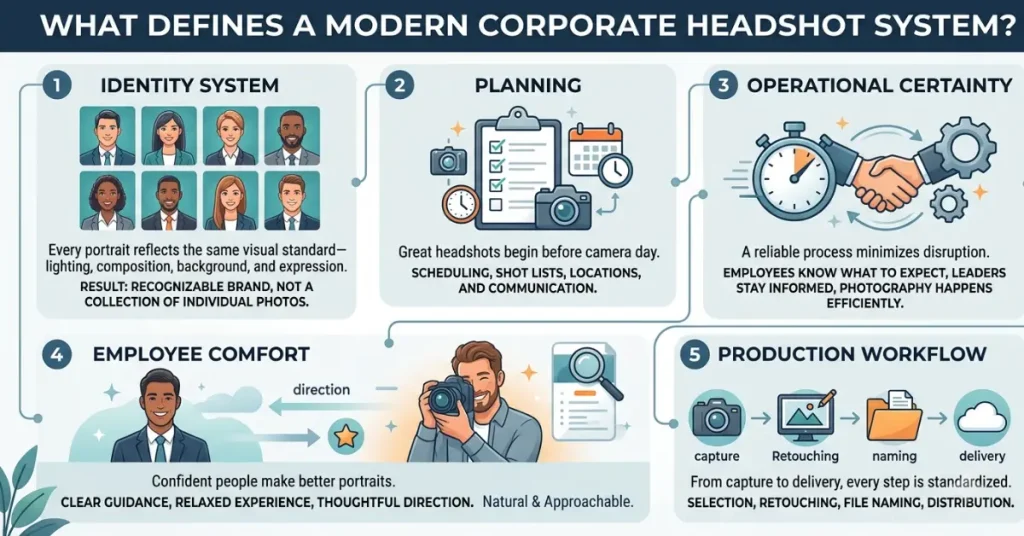
What actually defines a modern corporate headshot system
Most people still think corporate headshots are about lighting, lenses, or retouching.
That is outdated thinking.
In enterprise environments like a corporate headshots NYC project for a financial institution, the real value sits somewhere else entirely.
It sits in systems, consistency, and operational control at scale.
Corporate headshots are not photography — they are identity systems
A single image is not the product.
A repeatable identity framework is.
At scale, every employee image becomes part of a larger organizational structure:
- leadership visibility hierarchy
- employee trust representation
- brand consistency across platforms
- internal recognition systems
When viewed this way, headshots stop being creative assets.
They become infrastructure for how a company presents itself internally and externally.
That shift changes everything about how the work is designed.
Consistency is designed in planning, not editing
A common misconception is that consistency is achieved in post-production.
It is not.
Editing only refines what already exists.
True consistency is locked in during:
- planning phase decisions
- lighting system design
- background control setup
- direction methodology
If the system is inconsistent at capture stage, no amount of retouching can fix it.
In enterprise photography, planning is the real consistency engine.
Editing is only maintenance.
The real product is operational certainty under scale
At large organizations, the challenge is not taking a good photo.
It is producing hundreds of consistent outcomes without breaking operations.
That requires:
- predictable workflow design
- controlled timing per employee
- structured production flow
- minimal disruption to daily work
The client is not buying images.
They are buying certainty that the process will not fail at scale.
This is especially critical in regulated or structured environments like financial institutions.
Employee comfort directly impacts brand perception
This is one of the most underestimated variables in corporate photography.
If employees feel uncertain, rushed, or confused:
- expressions tighten
- posture becomes unnatural
- authenticity drops
That shows up directly in the final images.
And those images become public-facing brand assets.
So internal experience is not separate from brand output.
It is part of it.
A calm employee produces a credible image.
A stressed employee produces visual friction.
A corporate shoot is a production system, not a creative session
The biggest misunderstanding in corporate photography is treating it like a creative portrait session.
That approach breaks at scale.
Enterprise headshot systems require:
- structured production planning
- repeatable capture methodology
- controlled environmental setup
- standardized decision rules
This is closer to an operational workflow than an artistic session.
Creativity still exists.
But it is contained inside a system, not driving it.
That is what makes it scalable across 50, 100, or 1000+ employees without losing consistency.
What these insights actually reveal
Once you understand these principles, the entire category shifts.
Corporate headshots become less about:
- individual photos
- creative variation
- aesthetic preference
And more about:
- organizational identity design
- operational execution systems
- scalable brand consistency
That is the difference between a photographer delivering images and a system designer building corporate identity infrastructure.
17.Why This System Works
Differentiation Section
This is what separates a corporate headshot system from traditional photography services
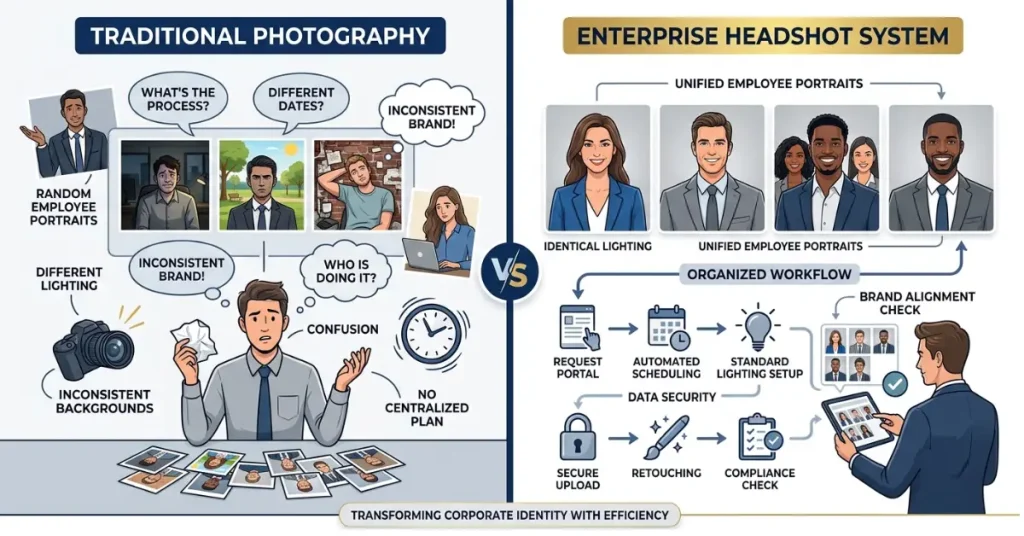
Most corporate photography fails for one simple reason.
It depends on interpretation instead of structure.
Different photographers. Different moods. Different outcomes.
That might work for small teams.
It breaks immediately at enterprise scale.
This system removes that uncertainty entirely.
Replaces subjective photography with repeatable system design
Traditional photography relies heavily on personal style and on-the-spot decisions.
That creates variation.
Variation creates inconsistency.
In enterprise environments like corporate headshots NYC projects, inconsistency becomes a brand risk.
This system removes subjectivity by replacing it with:
- defined lighting structure
- fixed production flow
- standardized direction framework
- controlled output rules
The result is not creative randomness.
It is predictable identity output across every employee.
Eliminates stakeholder friction
In most organizations, headshot projects create internal tension.
HR wants speed.
Marketing wants brand control.
IT wants technical compliance.
Leadership wants quality.
Without a system, these priorities conflict.
This approach removes that friction by design.
Everyone works from the same structure:
- same visual standards
- same approval logic
- same output expectations
There is no debate about “what looks right” during execution.
That decision is already built into the system.
Ensures brand alignment at scale
Brand alignment is easy when there are 10 people.
It becomes difficult at 100.
And chaotic at 1000.
The system solves this by locking visual identity at the planning level.
Every output is tied back to:
- lighting consistency rules
- expression direction standards
- framing and crop logic
- post-production boundaries
This ensures the brand does not drift as volume increases.
Whether it is executives or new hires, the visual language stays aligned.
No fragmentation across departments.
No visual hierarchy imbalance.
Just one consistent brand identity across all touchpoints.
Reduces operational burden on HR and Marketing
Without a system, HR and Marketing teams carry the load.
They coordinate schedules.
They manage approvals.
They resolve inconsistencies.
They fix file confusion after delivery.
That becomes a hidden operational cost.
This system removes most of that burden.
Because:
- scheduling is standardized
- outputs are pre-structured
- usage formats are predefined
- selection process is controlled
HR is no longer managing a photography project.
Marketing is no longer fixing inconsistent assets.
They are simply deploying ready-to-use identity assets.
Creates long-term visual continuity
Most corporate photography is treated as a one-time event.
That is where continuity breaks.
New hires look different.
Leadership updates feel disconnected.
Brand visuals slowly drift over time.
This system prevents that.
Every shoot is designed to match the previous one.
And to prepare for the next one.
That includes:
- lighting replication
- editing consistency rules
- framing standards
- archival system for future shoots
The result is a continuous visual identity over years, not isolated campaigns.
What this actually means in practice
This is not about better photos.
It is about reducing randomness inside large organizations.
When the system is in place:
- decisions become predictable
- teams stop conflicting internally
- brand visuals stay stable over time
- employee images become operational assets instead of creative variables
That is why the system works.
It replaces opinion with structure.
And structure scales.
18.CTA Section
Conversion Layer
This is where organizations decide whether they want a photoshoot or a system
If you are looking at corporate headshots NYC services, the real question is not availability.
It is structure.
Because most companies don’t actually need another photographer.
They need a consistent way to manage employee identity at scale.
That difference matters more than anything else in this process.
Enterprise headshot system inquiries
This service is built for organizations that are dealing with complexity, not simplicity.
Typical scenarios include:
- Large financial institutions with inconsistent employee imagery
- Companies scaling hiring across multiple departments
- Organizations recovering from merger-based visual fragmentation
- Teams where leadership wants a unified public-facing identity
If your current headshot library looks inconsistent across employees or departments, that is not a photography issue anymore.
That is a system gap.
This is where structured enterprise headshot systems become necessary.
Multi-location corporate shoots
Many companies operate across multiple offices in NYC or beyond.
That creates a common problem.
Different locations produce different visual outcomes.
Lighting changes.
Space changes.
Execution changes.
The result is fragmentation across the same brand.
This system is designed to solve that.
Multi-location shoots are standardized through:
- consistent lighting frameworks
- repeatable setup instructions
- unified direction systems
- centralized quality control
The goal is simple.
Every employee should look like they belong to the same organization, no matter where they were photographed.
NYC corporate photography services
This is not traditional portrait photography.
It is structured production for enterprise environments.
Designed for organizations that care about:
- brand consistency across digital platforms
- leadership credibility in public-facing channels
- employee representation across internal systems
- scalable onboarding of new hires
If your company is based in NYC and managing high-volume hiring or leadership visibility, the system approach matters more than isolated photos.
Because perception is not built on one image.
It is built on consistency across hundreds of them.
Request visual consistency audit
Most organizations don’t realize they have a problem until they see it clearly.
A visual consistency audit identifies:
- mismatched lighting styles across teams
- inconsistent cropping across platforms
- outdated employee imagery still in use
- leadership photos that don’t align with staff visuals
- fragmentation between departments or locations
This is often the turning point.
Because once inconsistency is visible, it cannot be ignored.
From there, the solution is not more photography.
It is a structured identity system that brings everything back into alignment.
Final note
If your organization is scaling, merging, or rebuilding its digital presence, the real risk is not poor photography.
It is visual inconsistency that grows quietly over time.
A structured enterprise headshot system prevents that before it becomes a brand issue.
That is the difference between random output and controlled identity at scale.